AA tutors Hikaru Nissanke and Jon Lopez discuss the unglamorous importance of repair and maintenance in architecture
AA tutors Hikaru Nissanke and Jon Lopez discuss the unglamorous importance of repair and maintenance in architecture
Matthew Lloyd Roberts: Jon and Hikaru, congratulations for being listed in the AJ’s 40 under 40 list! You’re currently teaching Experimental 1, I was wondering how you formed your ideas for the brief ‘About Time’?
Hikaru Nissanke: Last summer, both Jon and I began discussing a brief on the repair and maintenance buildings. Although initially concerned about its broad appeal among the student body, we agreed that it was important to pursue.
We started with the question: what contributes more social value, the quiet and proper maintenance of existing buildings, or the creation of new buildings with all their fanfare? Of course, these are not mutually exclusive, but it’s important to understand the role of optics and politics in the allocation of resources. When you scratch the surface, it’s clear that there is a crisis of care in the built environment, especially in British infrastructure projects, many of which are crumbling and in dire need of investment.
Culturally, we're very good at discussing celebrated buildings and architects, but less good at talking about architecture’s un-glamourous aspects – one of which is the repair and maintenance of what we have so that we don’t have to dispose of them later. Not everything is, nor can be, ‘high architecture’ and so we need to learn to work with it, not least of all for environmental reasons.
Jon Lopez: I think that writing the brief clarified certain ideas that we’d already had about buildings in use. There's something unique about looking at repair for instance, which is that the act itself is testament to an acknowledgement that something has gone wrong, or needs to be fixed. It’s also a practice that is able to re-centre the user in the process of design and the making of the space around them.
In that sense, the brief offered an opportunity to be quite realistic about the situation that we might face as architects and designers, in that the things you design might ‘fail’, but also to be quite optimistic about how you might build in strategies of how they might be corrected in the future. It was also a natural development from ideas we were tackling last year, which was about an acceptance that unexpected things happen, buildings get adapted and spaces are ‘misused’, perhaps in ways not envisaged by the first designers. We are enthusiastic that users find ingenious ways of engaging with the stuff you design and we wanted to open up that conversation a little bit more consciously by making time more manifest in discussions. This of course ties into very practical conversations about the lifespan of buildings, about future-proofing, all of which in practice has become crucial in how we think about material processes, building technology and construction.
Matthew: Do you see this agenda fitting into current questions around sustainability, retrofitting rather than demolishing buildings etc.
Hikaru: When we were studying, we had a shared frustration that so much was geared towards iconic and celebrity culture. That culture has unravelled somewhat, and as a profession we recognise the need for longer term planning of the built environment. There are so many different and inspiring discourses around how to go about this through environmentally and socially sustainable construction, and so yes, we imagine that we do fit under this broad umbrella. Stepping outside of our profession momentarily, there’s so much discussion around crumbling schools, collapsing bridges, and unsafe housing and we’re not sure that the solution is always more building. I guess we want to uproot a culture of short term-ism in thinking about how to respond to these crises first and foremost, and then to look at the available toolkit we have as both architects, but also as people. It’s easy to forget that we have agency beyond our profession too. What’s certain is that we need reform.
Matthew: How are those agendas manifesting in the students’ work?
Jon: As with every other unit, remote learning has brought a really interesting perspective to our teaching. Ordinarily we root briefs in place, but this year we might just share a method, or area of enquiry. This means that across the unit we are starting to evolve an understanding of the distinctive practices of maintenance and architectural care, depending on different cultures and geographies. It has brought a variety into the conversation that we’ve not often had before. We've got one student who's looking at the Westway, considering the kind of tactics through which that infrastructure has been occupied over time since its construction, and how either residents or local community groups have been able to respond to what is actually quite a brutal imposition on that part of London, trying to understand how that has affected certain groups more than others. I suppose that unpacks into a wider conversation about the disproportionate effects of large infrastructure projects on different communities.
Hikaru: There are really interesting cross-cultural connections being made in the unit. One student is looking at a Soviet model of housing, called Khrushchyovka that was imported to China, where it was built on a massive scale and has been incrementally adapted by its residents. Then we have a student in Moscow, looking at the same type of housing, examining its stigmatisation and scheduled demolition across Russia.
Jon: We also have a student looking at engagement with water within the context of Mumbai: the cultural and social significance of water, but also the practical considerations around sanitation, access to clean water and urban planning around sewerage.
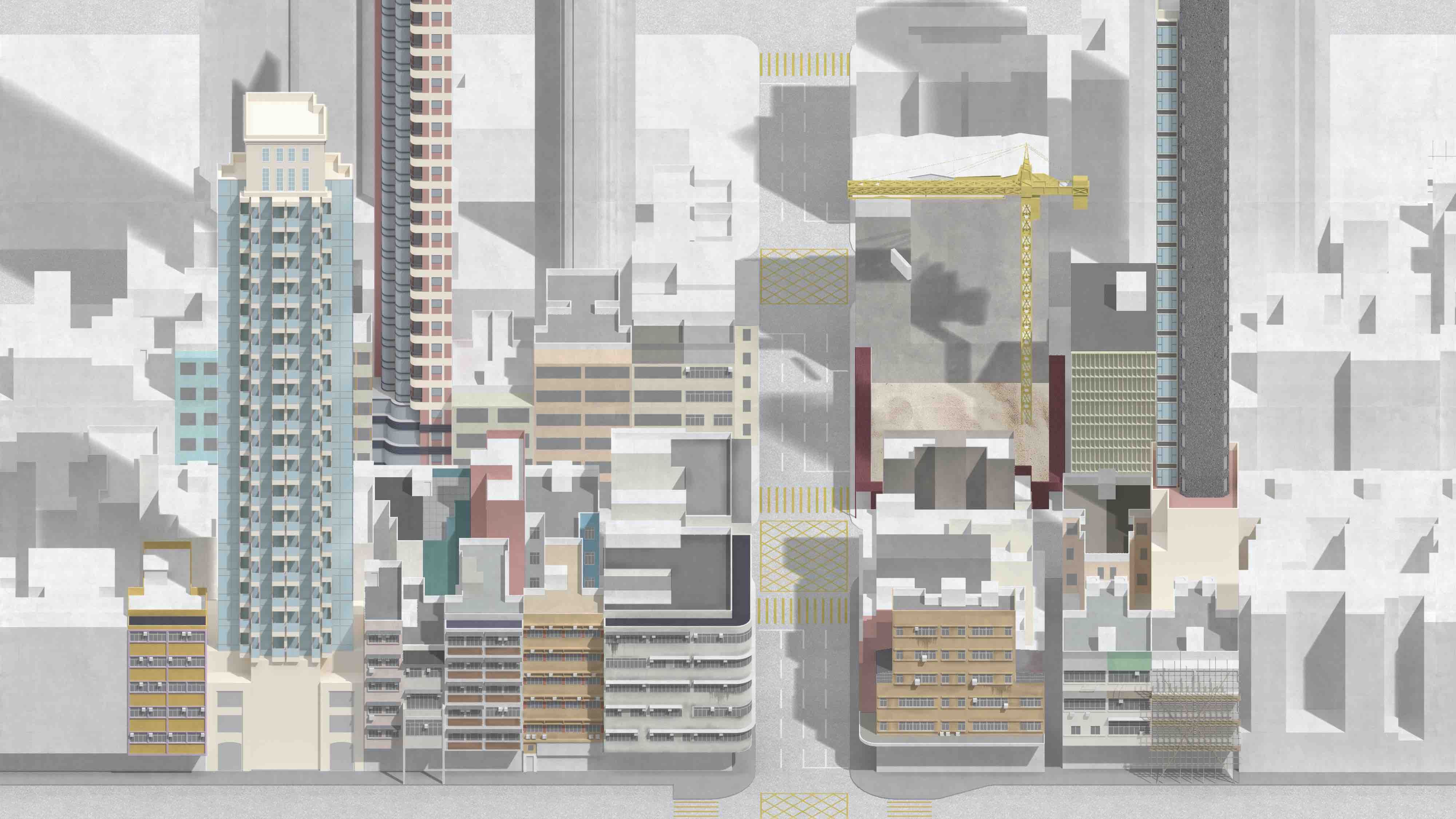
Hikaru: Another student is looking at high density housing in Hong Kong’s Old Town, and exploring strategies to curtail the intense overdevelopment of individual plots within a historic context.
Jon: Luca is looking at waste management in Rome, and making connections between the accretion of waste and Roman ruins, examining landfill practices on the edge of the city, partially about making it necessarily safer in the short term but considering and designing the much longer term future of waste.
Hikaru: Another, Bora, is looking at the ever present question of repair and maintenance, which is re-cladding projects in Britain. Examining the political consequences of the Grenfell fire, decision-making in planning departments and government, the failures of the insurance industry and the impact that this crisis is having on the mental health and security of so many. The students are dealing with these very big scales, thinking about the urban scale wherever they are currently living, all over the world. It has been really interesting to see them confronting their everyday surroundings and understanding how that urban condition has developed and evolved over time.
Jon: We started the year by saying your site starts from your desk outward. Partially, that was pragmatic because of lockdowns where students couldn't move very far, but we anyway wanted to get them to observe how the immediate reality of the places in which they live are being influenced by both global and local circumstances – and by using time as a register – see the ways in which the built environment is being shaped not just by its design, but through its use and maintenance.
Matthew: How does your teaching tie into the work you do with your practice, OMMX?
Hikaru: The biggest project that we're working on at the minute is Naked House, which we’re due to submit for planning this summer. There are lots of related themes to our brief around building affordable homes to accommodate change and exploring the social value of flexible and adaptable construction in the UK. Naturally, conversations we're having with the students are permeating back into the office, as the students are constantly making sense of our ideas and questioning them, trying to unpick what we're getting at. That's a really interesting kind of dialogue, we're very encouraging of them taking their own positions, so the student is acting as this kind of disruptive agent within the conversations that Jon and I might otherwise be having with the rest of our office. Then the practice also usefully grounds the questions we tackle in the unit: we want the students to think, how is this project going to get through planning? How are the people that live in this home going to afford to get a mortgage? There’s one side of our teaching which is about building a compelling vision that everyone can get behind. And then there's another equally important aspect, which is the really dry, nitty-gritty stuff that Jon and I love getting our hands dirty with, because that’s what makes these projects real and socially valuable, today and not just tomorrow. Both play a role in shaping our ethics, our values — those conversations are very live and feel unresolved in society.
Jon: It can be quite difficult, though, to convince students that the realities you face as a practitioner are an interesting thing to base a project around. I think it’s a good struggle to have, but I think it’s essential, for instance, to direct students to at least consider the mechanics and instruments of planning or conservation if they are working in a city like London. It's something that one would obviously come up against in practice, but it’s not without challenge to persuade a student that this might be an invigorating thing to focus their creative effort on.
Hikaru: I think, fundamentally, it might boil down to the fact that no one actually tells you what an architect is, because no one really knows what an architect does. Everyone, even RIBA, is asking what it means to be an architect at this moment. Lots of students come to architecture having seen, I don't know, Norman Foster and Bjarke Ingels. They have a very fixed image of what an architect is, usually a celebrity with a certain status. And I think part of our job is to challenge that image of an architect, to help students realise that it is a much more all-encompassing role. An architect doesn’t just make a house, or design an institutional building like a gallery or museum. I think to the public, that's what an architect is, because we're very bad at understanding or defining ourselves as a profession, what unites us all, which is much much more.
Image: Project by 'About Time' student Yui Ming Cheung
11 February 2021