Christopher Kokarev, AADipl(Hons)2020 discusses his Diploma project, the architecture of health and the history of Social Democracy
Christopher Kokarev, AADipl(Hons)2020 discusses his Diploma project, the architecture of health and the history of Social Democracy
Matthew Lloyd Roberts: Congratulations Christopher on being awarded Diploma Honours! How did your project develop over your fifth year at the AA?
Chris Kokarev: Fifth year began with my interest in the current status of the British welfare state and its problems, being from Finland and all. Throughout Term 1 I narrowed the theme down to health and wellbeing, more precisely public health. I don’t like the word ‘wellness’, and I’ve tried to avoid it as much as possible, but that sense of general mental and physical wellbeing within the public at large. I did a lot of historical research, which took me from Finland in the 1950s, when the post-war government did a lot of work to improve the wellbeing of the population, but my research took me even further back to Ancient Greece, where the term ‘Asclepeion’ originates. Asclepeions were these retreats and religious institutions where people could escape the stresses of urban life, particularly in regard to mental and spiritual health.
MLR: How did those ideas manifest themselves in your project?
CK: I chose London as my site for a couple of reasons: firstly, there was a strong tradition of public health initiatives, bathhouses etc. dating back to the 19th century. Over the course of the second half of the 20th century, many of those programmes were dissolved, particularly owing to privatisation. So today there is a distinct lack of institutions and places that people can visit to support their everyday health. I was trying to move away from the concept of health as a purely post-traumatic treatment. Our understanding of health shouldn’t be limited to the absence of injuries or diagnoses, but it should also encompass the everyday balance of both psychological and physiological wellbeing. It should be nurtured, but not in a sort of patronising way, not like under fascism, where exercise and “good health” was about social engineering and ethnological ideals, but my ambition was to generate something where people could truly retreat to, in order to help themselves feel better through what ever activity they need that specific day. In an ideal situation, nurturing people’s wellbeing this way might alleviate the stress caused by preventable disease on healthcare infrastructures in the long run.
MLR: We’ve discussed the ‘Asclepeion’ part of your project, but what about the ‘Vertical’?
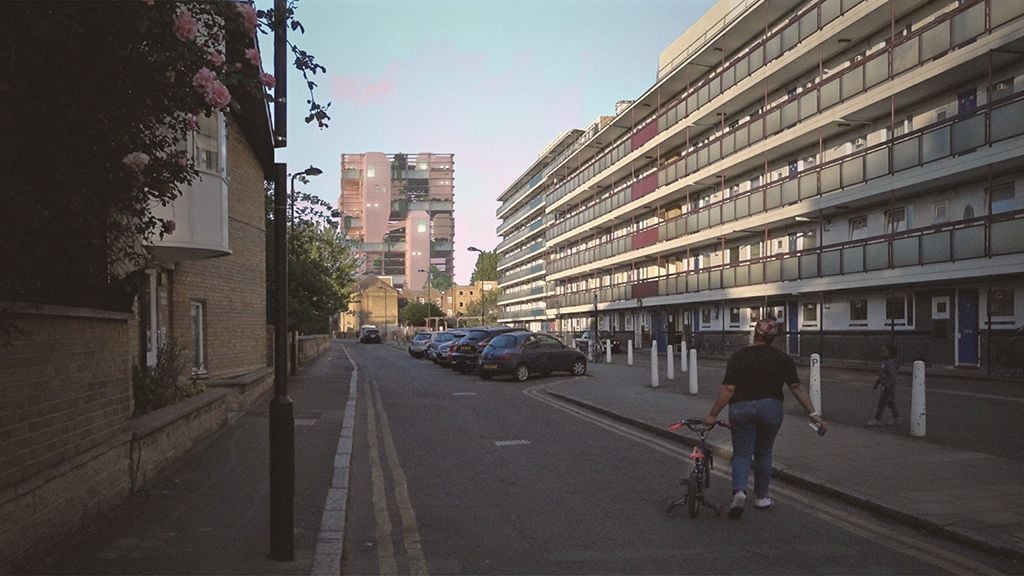
CK: Early on I decided I wanted to work within existing architecture as a site. One of the themes of the unit brief was reuse, the title being ‘Nothing is lost, nothing is created, everything is transformed.’ I thought that old tower blocks offered an interesting site to work with, due to their imposing scale and relationship to the surrounding city. As we discuss the importance of repurposing materials and even whole buildings today, my proposal directly aims to give a new life to these blocks that face demolition or dereliction. By placing these spaces for health atop towers, I wanted them to become beacons that impose the importance and dignity of the health and wellbeing of the general public over the city. The verticality also elevates the user away from the noise and the pollution of the street level, similarly to Asclepeions, which were purposefully placed in remote natural locations away from the polis. There is something poetic in these concrete skeletons being given a second life by the insertion of organic, or even organ-like structures of life and health.
MLR: That presumably has an ecological angle has well? Retrofitting structures to new uses?
CK: One could argue that it would be cheaper to demolish the whole structure and build something in its place, but the proposal actually sees 6 or 8 floors being used for interior spaces, with the rest exteriorised, which is an important aspect of the design because the rest of the interior then becomes a garden, which contributes to the ecological effects.
MLR: How do you see this project fitting into the history of the British welfare state?
CK: Britain has flirted throughout history with the idea of social democracy. There is a strong tradition of labour movements and socialism, but it never permanently wins the political argument. One case study I investigated was the Peckham Experiment (The Pioneer Centre), a communal building with a library, a pool, spaces for exercise and a cafeteria. The project was organised by two doctors in the mid 20th century interested in the totality of healthcare as a nurtured and social way of living, which never quite caught on at a large scale, partly due to the victory of neoliberalism in the late 20th century. Seeing the increased appreciation for public health services in the wake of the pandemic made me hopeful about its future – perhaps this display of public attitude would underline the importance of the public healthcare infrastructure and the need for its development.
MLR: How would you like to change healthcare policy in the UK?
CK: We need to start thinking in the long-term about health infrastructure. By providing infrastructure that supports pre-diagnosis solutions around lifestyle and mental health we massively reduce the pressure on post-diagnosis services, which currently do too much of the work in our healthcare system. I hate the word ‘better’, when we’re talking about these reforms, since I’m not interested in patronisingly forcing people to make ‘better’ lifestyle choices, but giving people the resources and the spaces they need to be empowered and in control of how they can make themselves feel well that specific day of the week. In Finland there’s a strong tradition of public bathing and sauna which provides support every day to so many people, which brings people from all backgrounds joy, especially in the cold and dark winter months. I’m not saying we should copy the Finnish model, as they are very different societies with different norms, but my project is about providing people with spaces to pursue their interests, a space that helps them balance out their daily social and physiological needs.
Deep down, I believe that the age-old struggle for public space is so important. We must think very hard about what we actually mean, when we talk about public space for the people. It’s not just about proposing empty spaces with patches of grass and some benches in between office towers, but in fact it should be about providing opportunities for people to do (fun) things that can be hard to do in private, often small (at least for the most of us in London) homes.
I think of this project as a proposal for a different kind of public space. The majority of British people need more public space, especially in big cities, and the question of the future nature of public space is what I want to tackle in my future work.
18 September 2020