Hamed Khosravi publishes multiple journals and papers
Hamed Khosravi publishes multiple journals and papers
Hamed Khosravi, Unit Master in Diploma Unit Fluid Territories: The North Sea and Projective Cities staff, publishes multiple journals and papers with Humboldt Books, Mousse Publishing, the Journal of Architecture and Culture, and the Journal of Urban Planning.
The architecture of logistics is profoundly political. It measures, maps, and modulates the terrain through its projection of power-relations onto the topography. It creates spatial networks that are constituted through the circulation of capital and calibrated to meet the requirements for security and risk management. Such a direct translation of risk factors and economic values into a spatial configuration inevitably produces a territory that is alienated from both the natural topography and forms of labour. The book is an inquiry into the nature of changing paradigms in logistics. It aims to offer a cross-disciplinary platform for an exchange of ideas among artists, architects, historians, philosophers, engineers, and planners. We believe that it is only through cultivating a common imaginary that we will be able to know, resist, and effectively work against and from within the logistical system that shapes our lives, territories, and cities.
‘Tehran’ by Hamed Khosravi and Giovanna Silva is published by Mousse Publishing.
In 2018, Italian photographer Giovanna Silva photographed the streets of Tehran and collected archival documents from the infamous American embassy in the capital of the Islamic Republic. The image-based work is part of a multi-layered narrative that encounters the words of architect, researcher and educator Hamed Khosravi. His contribution to the book is part of an ongoing research on social movements and their relationship with architecture. He traces the historical relevance of writer Maryam Firouz, architect Noureddin Kianouri, and their involvement in the progressive journal Bidari-e Ma (Our Awakening).
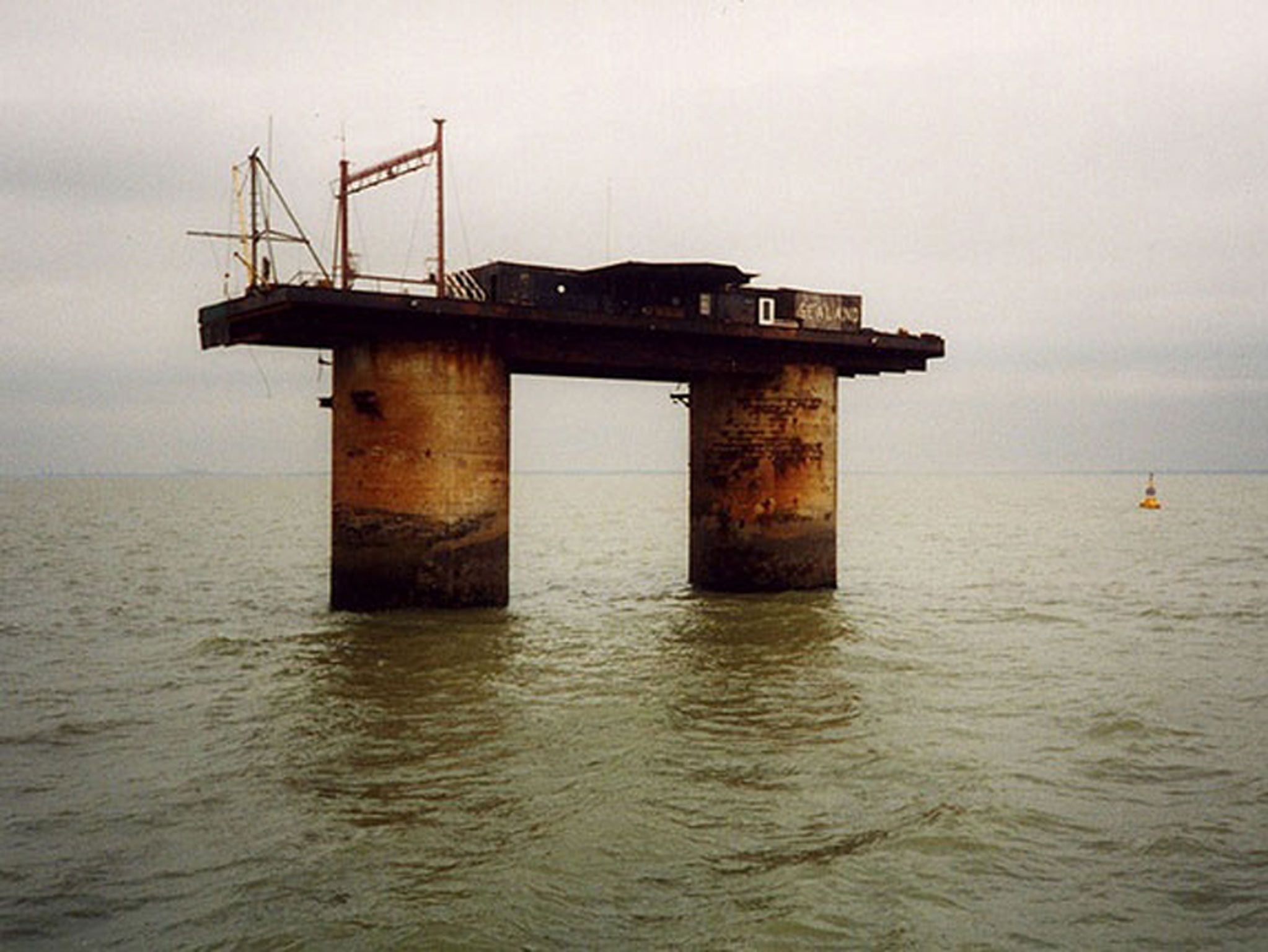
Focusing on the small state of Sealand, a platform built off the English Essex coast to carry anti-aircraft guns during the Second World War, this article posits the North Sea as a particular geopolitical condition based on its status as a “state of exception.” The article formulates its reading by considering the architectural legacy of the pirates, privateers and hackers who have been the principle rulers of the terrain. Their spatial strategies are understood not only in terms of physical constructions that accommodate exceptional functions, but also as a conceptual apparatus that facilitates extraterritorial juridical practices. The spatio-juridical characteristics of the “architecture of the sea” are seen to offer new possibilities for ordering the distribution of goods, capital and information, and for alternative forms of living.
The aftermath of WWII not only marked the beginning of a new geopolitical order but also once again brought discourses of architecture and planning back to the frontline of the confrontations between the West and the Soviet blocs. Although the immediate need for post-war reconstruction left almost no time for contextual theoretical development in architectural and planning principles, the “occupied” and “liberated” territories became laboratories in which the new concepts of urban form, domestic architecture, and forms of life were tested. During 1945–1967 Tehran became one these experimental grounds in which these planning principles were tested and implemented; a battleground where the socialist and the capitalist ideologies met. The key to this urban development project was an ideologically charged repercussion of the CIAM (Congrès Internationaux d’Architecture Moderne) discourse, specifically on Existenzminimum (1929) and Rationelle Bebauungsweisen (1930). While the CIAM’s agenda had already found its way to Iran through one of its founding members, Gabriel Guevrekian, it became operative through the activities of the Association of Iranian Architects who were in charge of major housing developments in Tehran since 1945. Thus, CIAM guidelines were translated into building codes, regulations, and protocols that had the fundamental role in shaping the Middle East’s first modern metropolis. New housing models were developed and proposed by the Association of Iranian Architects that cut ties with the traditional typologies and proposed a radically new urban form, architecture, and forms of life. This project at large, of course, was not politically neutral. This article reviews the role of two protagonists in introducing and revisiting the CIAM discourse in shaping the post-war neighbourhoods and housing typologies in Tehran.
11 October 2019