Animal Architectures
Animal Architectures
3 November 2020
Time
6–7.30pm
Location
Zoom
As architects we often assume that our clients will always be humans but what about when the architectural inhabitants are animals? What agency do animals have in the design of their spaces and cities and how can we design with them rather than just for them? This discussion will address the role of the architect in designing animal architectures or spaces that are beneficial to all species.
Animalesque City: Visions for human/animal cohabitation – Jorge Godoy Roman, Ana Zatezalo Schenk, Sjoerd Krijnen and Florentin Steininger
Over the past three years, the Animalesque Berlin Visiting School has been committed to investigating the meaning and potential of animal wildlife in the city, and to stimulating design that is beneficial to all species. The Berlin-based team is formed of Jorge Godoy Roman, Ana Zatezalo Schenk, Sjoerd Krijnen and Florentin Steininger. Working collaboratively with designers, ecologists, biologists, artists and academics, among others, Animalesque stimulates transdisciplinary research and design that responds to the growing complexities of an urban/natural world.
After introducing insects as the first layer of animal life in the 2018 Visiting School, the research scope was extended to birds in 2019, resulting in the design and construction of a giant nest in the Floating University basin. Adapting and responding to the current pandemic reality, the Animalesque Visiting School Competition invites students to participate in the production of short radical and visionary movies about the future agency of animals in the design and construction of urban environments. We are mammals, but our anthropocentric perspective has unbalanced our position within the animal kingdom and within the natural world as a whole. Can we build new scenarios for symbiosis with the species that inhabit the world and live alongside us?
Architecture for Pigeons – Ahmed and Rashid bin Shabib
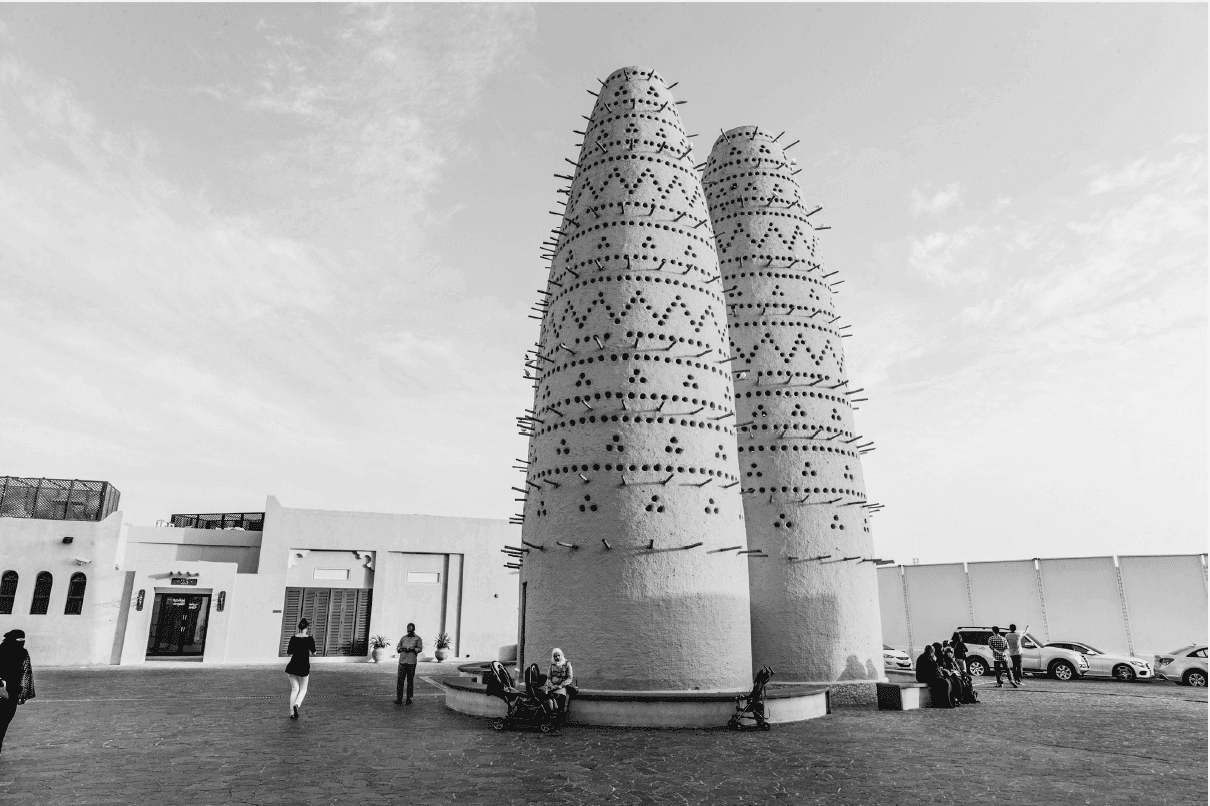
Pigeon houses are perhaps one of the most understudied forms of architecture. Even more unknown is the knowledge and science surrounding their intention. One of the oldest known structures, pigeon houses across the Middle East and North Africa have contributed significantly to their architecture heritage. First and foremost, these were communication towers, where magneto-recepting pigeons exchanged messages between cities, countries and continents. These towers act as a device for agriculture, food, security, and fertilization. The vernacular character of pigeon houses across the region is consistent, and has few iterations. Those ones who continue its craft and tacit knowledge are local craftsmen.
In this workshop, we shall attempt to construct a Pigeon tower following examples from Siwa, a salt Lake District on the western part of Egypt bordering Libya. We are going to work with salt, clay, bricks, wooden beams, and the knowhow of Siwani Craftsmen who across generations continue this tradition of non pedigreed architecture.
Based in Dubai, Ahmed and Rashid bin Shabib are urbanists and researchers of cities across the Middle East and North Africa. They are the founders of Brownbook, a magazine that documents cities across the the region. They have also curated several exhibitions and collaborations including the Boisbuchet (2021), UAE National Pavilion in Venice (2021), Lars Müller Publishing (2019), AA (2018), Vitra Design Museum (2017), Serpentine Gallery (2016), UAE Pavilion Milan Expo (2015). They both studied urbanism and architecture at the University of Oxford and Cambridge, and have been nominated for the Aga Khan Award for Architecture in 2010 and 2019.
Story of an Elephant – Shin Egashira
Before the fossil fuels and communication technologies had replaced them, for a long time, animals carried many stories across continents and between cities. Horses were motorcycles and pigeons were today’s equivalents to the internet. Story of an Elephant is a reverse journey of this mythical giant in poem, song, prints and photographs. It ponders, with the help of whimsically combined analogue and digital tools, why does progress tend to follow from the old to the new? Why do cultural artefacts tend to travel from the west to the east, the knowledge from the centre to the peripheral, while natural resources move in opposite directions?
Shin Egashira makes art and architecture collaboratively worldwide. His experiments include the construction of Alfred Jarry’s Time Machine alongside astrophysicist Andrew Jaffe; ‘How to Walk a Flat elephant’ and ‘Twisting Concrete’ which fuse old and new technologies. He conducts a series of landscape workshops in rural and inner-city communities across the world. He is Unit Master of DIP11, with whom he has been critically documenting neoliberal urban development in London. Shin holds visiting professorships at Tokyo National University of Fine Arts and Music and the University of Hong Kong.
--
Manijeh Verghese is Head of Public Programmes at the Architectural Association, where she is also a Unit Master of Diploma 12 and a seminar leader for the AA Professional Practice for Fifth Year course. She is a founding Director at Unscene Architecture and co-curator of the British Pavilion at the 17th Venice Architecture Biennale. Over the past eight years, she has led postgraduate and undergraduate design studios at both the AA and Oxford Brookes University and has taught workshops and courses across universities in the UK and abroad. Previously, she has worked for architecture practices including John Pawson and Foster + Partners, and has contributed to design publications such as Disegno and Icon, as well as think-tanks, books and peer reviewed journals.
This event is part of the programme around the exhibition: A Playground for Non-Humans delivered in collaboration with Japan House London, and inspired by the Architecture for Dogs exhibition.