Architecture for Extreme Environments
Architecture for Extreme Environments
18 February 2022
Time
3.30–9.30pm
Location
Online
This symposium looking at The Architecture of Extreme Environments has been organised by Kais Al-Rawi, Nerma Cridge and Xavier De Kestelier as part of the AA MARS Visiting School Programme in collaboration with the AA Public Programme.
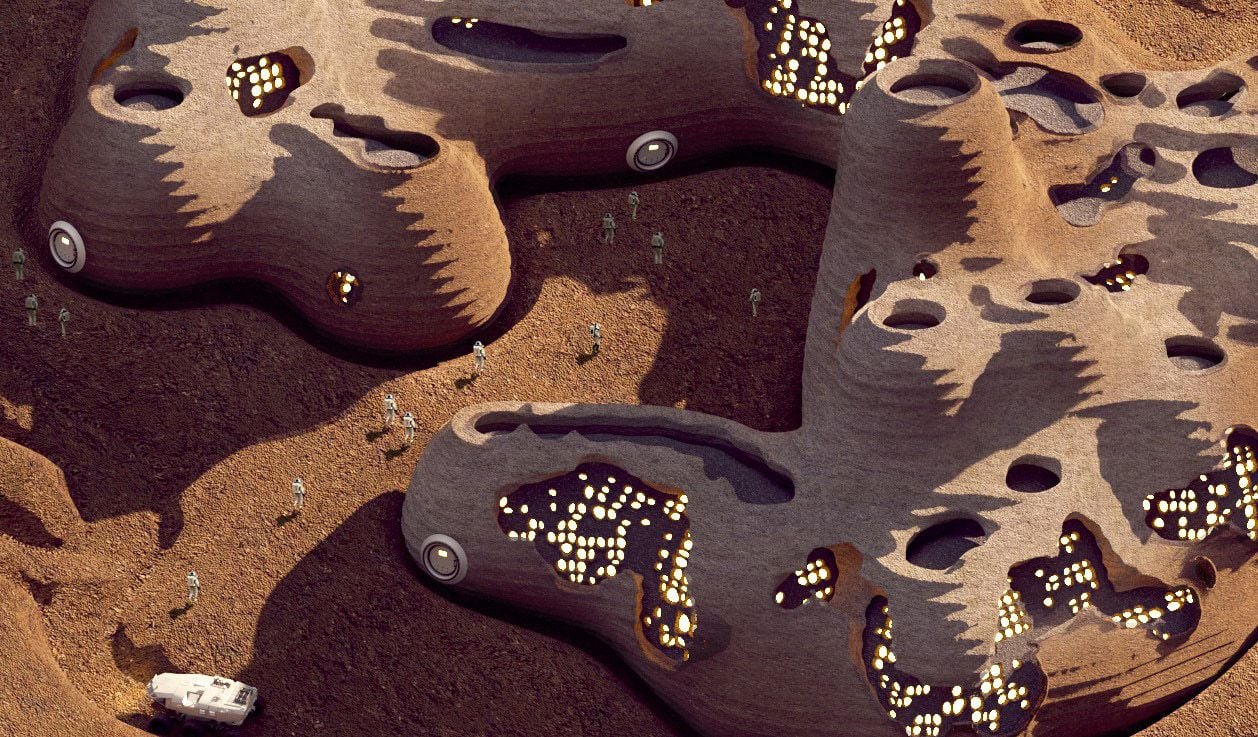
The symposium spotlights the unique architecture, engineering and construction opportunities and challenges within extreme environments through a series of presentations and discussions by world leading experts. Four distinct environments frame the sessions of the symposium: Desert, Oceanic, Polar and Space. The challenges of extreme environments have allowed architects and engineers to envision novel and creative solutions with vast applicability, often converging through the theme of material and resource efficiency as a key pillar for sustainable development in extreme environments.
The online symposium will be available virtually to participants globally and will be followed by a series of three-day design and technology workshops organised by the AA Mars Visiting School programme.
Schedule: (all times are PST / EST / GMT)
7:30 AM / 3:30 PM / 10:30 AM – Introduction
Session 1 – DESERT
7:45 AM / 10:45 AM / 3:45 PM– Arthur Mamou-Mani | Mamou-Mani
8:05 AM / 11:05 AM / 4:05 PM – Mazen AlAli | Rum Atelier
8:25 AM / 11:25 AM / 4:25 PM – PANEL Q&A chaired by Kais Al-Rawi
Session 2 – OCEANIC
8:55 AM / 11:55 AM / 4:55 PM – Michael Gernhardt | NASA
9:15 AM / 12:15 PM / 5:15 PM – Heidi Pettersvold | Snohetta
9:35 AM / 12:35 PM / 5:35 PM – Duncan Phillips | RWDI
9:55 AM / 12:55 PM / 5:55 PM – PANEL Q&A chaired by Nerma Cridge
break (5 mins)
Session 3 – POLAR
10:30 AM / 1:30 PM / 6:30 PM – Polly Gould | UCL
10:50 AM / 1:50 PM / 6:50 PM – Hugh Broughton | Hugh Broughton Architects
11:10 PM / 2:10 PM / 7:10 AM – Sebastian Frederiksen and Karl Johan Sorensen | SAGA
11:30 AM / 2:30 PM / 7:30 PM – PANEL Q&A chaired by Nerma Cridge
Session 4 – SPACE
12:00 PM / 3:00 PM / 8:00 PM – Melodie Yashar | ICON
12:20 PM / 3:20 PM / 8:20 PM – Anna Talvi | Microgravity Technologies
12:40 PM / 4:30 PM / 8:40 PM – Michael Najjar | Studio Michael Najjar
1:00 PM / 4:00 PM / 9:00 PM – PANEL Q&A chaired by Xavier De Kestelier
1:30 PM / 4:30 PM / 9:30 PM – end
Speakers:
Kais Al-Rawi AIA works at the intersection of architecture and engineering. He is a Senior Associate at the Los Angeles office of Walter P Moore & Associates, he has worked on the structures and enclosures of complex projects at a multitude of scales and typologies, ranging from art-forms, to stadia, museums and airports. He is a licensed Architect in California and holds a Masters degree from the Architectural Association (AA) in London as well as an undergraduate degree in Architecture from Ryerson University in Toronto. He initiated the Jordan Visiting School in Jordan in 2014 and he has since then led the programme with a focus on space architecture on MARS; he recently served as a judge in NASA's 3D Printed Habitat Challenge.
Arthur Mamou-Mani AA Dipl, ARB/RIBA FRSA is a French architect, and director of the award-winning architecture practice Mamou-Mani, specialising in a new kind of digitally designed and fabricated architecture. Arthur is a lecturer at the University of Westminster, and has given numerous talks around the world on “Eco-Parametric” architectural practice, including two TedX conferences in the U.S. and France. A fellow of the Royal Society for Encouragement of the Arts Manufacture and Commerce, he has won the American Architecture prize, the RIBAj Rising Star Award and has recently been awarded the prestigious Pierre Cardin Prize for Architecture from the Academie des Beaux-Arts in France. In 2020 the Architects Journal named Mamou-Mani one of it's 100 ‘Disruptor’ practices who are challenging the norms of traditional architecture practice in their drive to bring about sustainable alternatives. Alongside his architectural practice Arthur founded the digital-fabrication laboratory FabPub, allowing the public to experiment with large-scale laser cutting and 3D printing equipment in Hackney, London.
Mazen Al-Ali is a Jordanian Architect, Author, and multidisciplinary designer, based in Amman Jordan. Currently, the principal architect at RUM Atelier, working alongside Teaching CAD software, fabrication, technology-aided manufacturing, parametric, and Computational design software at many academic institutions and companies alongside consulting for many design firms, initiatives, and individuals and has helped to establish many production and fabrication studios locally and internationally. Mazen Has been also working on developing environmental building concepts based on its Biological structures and natural processes in many projects such as the “Earthintaer project” endorsed by the Biotecture Global. In 2015 he has been appointed the architecture association school of architecture student ambassador for the AA visiting school Jordan as he is currently teaching as a unit instructor with the AAVS Jordan.
Dr. Nerma Cridge completed her education in architecture at Birmingham, the Bartlett and the Architectural Association. Since qualifying, she has worked for a number of distinguished practitioners. Her first monograph Drawing the Unbuildable was published by Routledge in 2015. Nerma currently teaches at the AA in the History and Theory Studies and Design Research Laboratory and several other UK universities, as well as running her own art and design practice, Drawing Agency. Her most recent publication includes Restless:Drawn by Zaha Hadid a chapter in Routledge Companion to Women in Architecture edited by Anna Sokolina.
Mike Gernhardt started his career as a professional deep sea diver, became Vice President of Oceaneering International. He later founded Oceaneering Space Systems, with the goal of transferring subsea technology and operational methods to the NASA space program. He then was selected as an Astronaut , flew four space missions including doing the first space walk from the International Space Station. Throughout his NASA career he led the development of all the pre-breathe protocols used for doing space walks from the ISS. He has also led the development and testing of a small pressurised rover system optimised for for space walks. He also co-lead a range of analogue tests over the years, including NEEMO, Desert Rats and the Pavilion Lake research project.
Heidi Pettersvold has worked as an interior designer for more than 20 years. She graduated in 1993 after spending her last semester at the Middlesex University in London as an exchange student. After finishing her master study in interior she started to work for the Interior agency RISS in Oslo. After 8 years practice there she was asked to join Snøhetta as they were expanding their interior department. Heidi has worked on various projects for Snøhetta such as the Reindeer Pavillion at Hjerkin, Dovre, The Regionals department for Heinemann Duty Free at Gardermoen Airport, several restaurant locations for Bølgen & Moi in Oslo as well as Barr in Copenhagen, and the National Academy of the Arts in Oslo (KHiO) and the National Academy of Arts in Bergen (KHiB). In recent years, key projects include Gullhaug Torg, a mixed used FutureBuilt pilot project aiming at Triple Zero, and the renowned underwater restaurant Under in Southern Norway.
Duncan Phillips is RWDI's Global Practice Leader for Building Performance, heading up a talented pool of building performance engineers and scientists as they develop climate-responsive design strategies for individual buildings and masterplans. RWDI's clients benefit from Duncan’s ability to solve tough building physics problems by analysing air flow and heat transfer phenomena. These capabilities have applications in ventilation strategies as well as renewable energy. Duncan is a critical player in RWDI's efforts to both diminish buildings’ contribution to climate change through passive and low-energy design, and to design for future climate scenarios by increasing buildings’ resilience to extreme weather events.
Dr Polly Gould is an artist, writer and curator. She teaches at the Bartlett School of Architecture and Royal College of Art and was Post-doctoral Fellow in Design-led Architectural Research at Newcastle University from 2016-19. In 2012 as part of Eggebert-and-Gould she curated TOPOPHOBIA: Fear of Place in Contemporary Art. She shows with Danielle Arnaud in London. Her recent show in 2020 was titled Architecture for an Extinct Planet. A related essay titled 'Architecture for an Extinct Planet: Birds of Paradise', was published in Less a Building: Interactions with the London Zoo Aviary in ed Michaela Nettell, Passengers, 2021. Gould’s current interest is in writing ecocriticism of the histories and futures of extreme environments with post-colonial, feminist and new materialist readings of the biographies of Victorians such as John Ruskin and John Tyndall. Book chapters include ‘Molar Heights and Molecular Lowlands: Scale and Imagination in Ruskin and John Tyndall’ in Ruskin's Ecologies: Figures of Relation from Modern Painters to The Storm-Cloud, eds, Kelly Freeman and Thomas Hughes, Courtauld Books Online, and 'Ruskin's Storm-Cloud and Tyndall's Blue Sky: New Materialist Diffractions of Nineteenth-Century Atmospheres' in Ecocriticism and the Anthropocene in Nineteenth- Century Art and Visual Culture eds. Coughlin and Gephart, 2019. The material culture of watercolour and polar histories of exploration through the biographies of explorer Edward Wilson and the anthropologist Franz Boas are the at the heart of in her recent book Antarctica Art and Archive, published by Bloomsbury, 2020, for which she received a Paul Mellon publications grant.
Hugh Broughton founded Hugh Broughton Architects in 1995. In 2005 Hugh’s practice won an international competition for the design of the UK’s most southerly Antarctic research station – Halley VI. The modular elevated base was completed in 2012 and is the world’s first fully relocatable polar research facility. Hugh’s practice has gone on to win a string of design competitions for remote projects and is now considered one of the world’s leading designers of research facilities in the Polar Regions. His projects include: Halley VI Antarctic Research Station for the British Antarctic Survey, Juan Carlos 1 Spanish Antarctic Base, Modernisation of Rothera Research Station for British Antarctic Survey, Scott Base Redevelopment for Antarctica New Zealand, Davis Station Redevelopment for Australian Antarctic Division, Atmospheric Watch Observatory in Greenland for the US National Science Foundation. Hugh has won over 50 international awards for his designs. His work has been published around the world and has been featured in numerous exhibitions and on television and radio. He has lectured worldwide on the work of his practice, and regularly sits on award and competition juries.
Sebastian Aristotelis is a co-founder and lead architect at SAGA Space Architects. He was educated at The Royal Danish Academy of Fine Arts and the International Space University. With Karl-Johan and the rest of SAGA, he designed and built the LUNARK habitat and lived in it for three months. His main interests lie in making space livable for future space travellers by approaching the design of habitats from a human perspective.
Karl-Johan Sorensen is a co-founder and former architect at SAGA Space Architects. He is educated at The Royal Danish Academy of Fine Arts, the International Space University, and is currently studying mechanical engineering at the Danish Technical University. With Sebastian and the rest of SAGA, he designed and built the LUNARK habitat and lived in it for three months. He is passionate about using computational design and digital fabrication to develop novel construction systems.
Xavier De Kestelier is a global Head of Design and leader at Hassell design technology and innovation team, which sets strategy and advises on the tools and knowledge we need to succeed. Both an architect and technologist, Xavier harnesses technology to create more powerful, future-focused design solutions. That means he’s responsible for overseeing our work in computational design, building information modelling, visualisation and virtual reality worldwide. Over the past decade he’s forged a reputation as an industry leader in the exploration and adoption of parametric design and digital fabrication. Most recently, he was behind our concept for a ‘home’ on Mars – part of NASA’s 3D Printed Habitat Challenge.
Melodie Yashar is a design architect, technologist, and researcher. She is the Head of Building Design & Performance at ICON, a startup pioneering the future of 3D-printed housing for Earth and space. She also teaches undergraduate and graduate topic studios at Art Center College of Design. In previous roles Melodie was a Senior Research Associate with the Human Systems Integration Division at NASA Ames via San Jose State University Research Foundation (SJSURF), an Associate Researcher with the UC Davis Center for Human/Robotics/Vehicle Integration and Performance (HRVIP), as well as a co-founder of Space Exploration Architecture (SEArch+). Her background is in industrial design, architecture, and human-computer interaction with an emphasis in robotics.
Anna Talvi is currently pursuing a PhD at the UCL, Bartlett School of Architecture, in partnership with the European Space Agency. Her interdisciplinary research focuses on developing a 4-dimensional microgravity-specific astronaut's body mapping and a topological framework to predict the mechanical behaviour of knitted structures for next generation space suits. Talvi is also the founder of Microgravity Technologies, a startup developing technology for automated generation of knit instructions for 4D CNC-knitted structures.
In his artwork Michael Najjar takes a complex critical look at the technological forces shaping and drastically transforming the early 21st century. Najjar’s photographic and video works exemplify and draw on his interdisciplinary understanding of art. In his artistic practice he fuses art, science, and technology into visions of future social structures emerging under the impact of cutting-edge technologies. Since 2011, he has been working on the topic of space exploration. His "outer space" work series deals with the latest developments in space exploration and the way they will shape our future life on Earth, in Earth’s near orbit and on other planets. The cultural dimension represented by the transition process towards a larger human presence in space is very much at the center of Michael´s work. The performative aspect has also become a fundamental part of Michael´s work process and will culminate in his own flight into space. As one of the pioneer astronauts of Virgin Galactic, he will be embarking on SpaceShipTwo on one of its future spaceflights.
To attend the symposium, please sign up on eventbrite:
General Admission: £25
Students: £10
AA members: FREE - please email visitingschool@aaschool.ac.uk for concession code
To become an AA Member, please visit: https://www.aaschool.ac.uk/membership