Colonialism as Climate Change
Colonialism as Climate Change
28 January 2020
Time
7.30–9pm
Location
AA Lecture Hall
Eyal Weizman presents a lecture exploring the relations among colonial history, contemporary conflicts, and climate change. The talk examines a number of cases on environmental issues that Forensic Architecture has undertaken on the subject in recent years. He takes as his point of departure the growing number of conflicts that unfold in relation to climatic and environmental transformations. On a global scale, some of these conflicts take place along environmental threshold conditions (‘conflict shorelines’), the edges of forests and deserts, in which climate transformations aggravate existing political tensions. Weizman argues that these conflict shorelines are not simply determined by climatic factors. In this talk he exposes the deeply complex historical and natural processes at play, bringing together political developments, urban transformations, colonial histories, and patterns of city growth and migration in relation to changing climatic conditions.
Eyal Weizman is an architect, Professor of Spatial and Visual Cultures, and Director of Forensic Architecture. He is a founding member of the architectural collective DAAR in Beit Sahour/Palestine and a member of board of directors of the Centre for Investigative Journalism. His books include Forensic Architecture: Violence at the Threshold of Detectability, FORENSIS, Mengele’s Skull (with Thomas Keenan), The Least of All Possible Evils, and Hollow Land. He has recently been made a fellow of the British Academy.
----------
The seminar introduces the means and modes by which architecture — as a contemporary set of techniques and as a body of knowledge — can become an investigative and evidentiary mode through which to interrogate contemporary politics and conflict.
Conflicts are urban phenomena, played out within dense media and data environments. Political violence no longer focuses on the control of territories, but rather on the governance of population. From the use of tear gas to choke protestors, through to humanitarian governance of populations in the global south, to machine learning mobilisation of face recognition and biometric fingerprinting, the body is once again the focus of systems of government and control. This year the seminars will concentrate on concepts of biopolitics.
There has been some important shifts in our contemporary techno-political landscape since Foucault first formulated and Agamben re-articulated the term biopolitics. While their formulations were fundamental in identifying modes of governmentally and control of humans as mere bodies in space, the question associated with the term biopolitics today must shift in two different ways: on the one hand it must account for the techno-biological nature of the human in which the border between technology and biological matter erodes. It must also turn to engage larger ecologies in which the “bio” in biopolitics designate all living matter now under threat of extinction.
This open seminar series comes to map out the shifting landscapes articulated around the term biopolitics and the ways it could become relevant today.
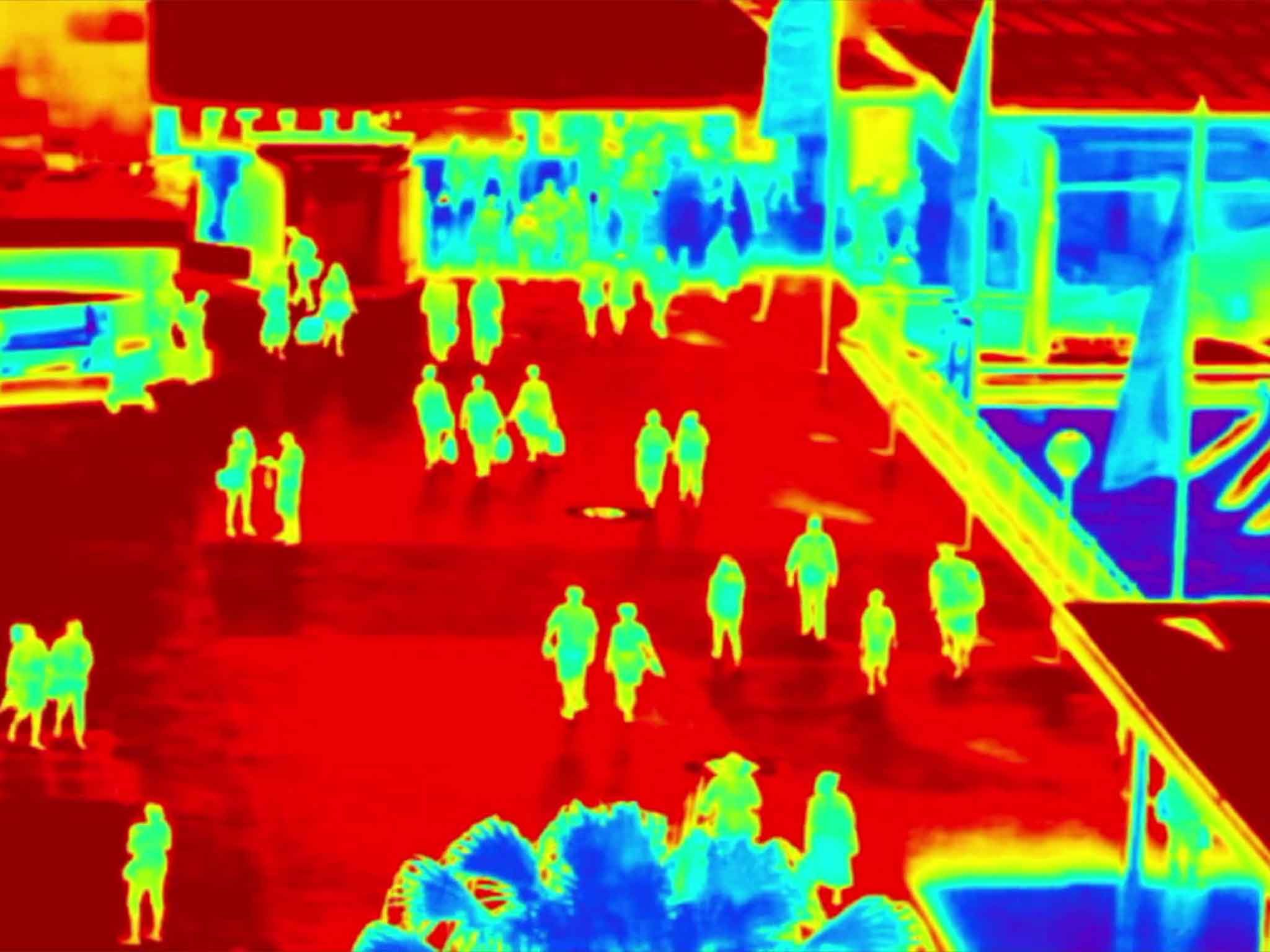
Image: Infrared thermal imaging of bodies, scopesman.com, 2019