Designing for Non-Humans
Designing for Non-Humans
5 November 2020
Time
11am–12.30pm
Location
Zoom
Join the winners of the Architecture for Non-Humans competition along with architects who contributed designs to the Architecture for Dogs show currently on display at Japan House London, as well as architect and AA Council Vice President Catherine du Toit and critical designer and AA graduate Ioana Man to discuss what it means to design for non-humans in our cities today. How can we encourage a wilder ecology within our urban environments so they can be inhabited equitably by humans, animals, microbes and more?
Presentations include:
Toyo Ito – Mobile Home for Shiba
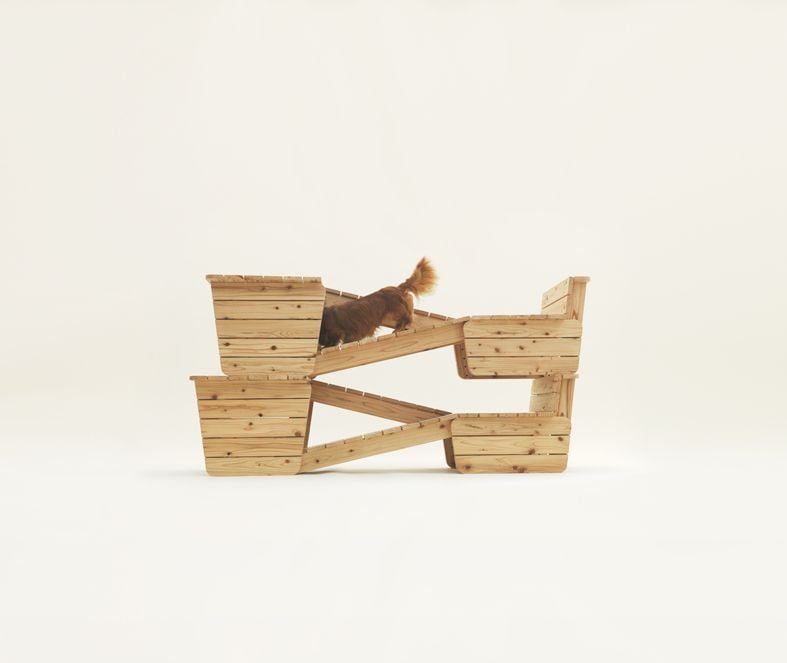
Yoshiharu Tsukamoto (Atelier Bow Wow) – Architecture for Long-Bodied Short-Legged Dog
Catherine du Toit - When ancient meets future
Ioana Man - Living with Microbes
Camille Bongard, Matis Barollier, Cesar Jucker – Climb the Note
Toyo Ito is an architect and founder of Toyo Ito & Associates, Architects. After graduating from the University of Tokyo in 1965, he worked in the office of Kiyonori Kikutake until 1969. In 1971, he founded his own office Urban Robot (URBOT), which was renamed Toyo Ito & Associates, Architects. He has won a series of awards and prizes including: the Golden Lion from the International Architecture Exhibition - La Biennale di Venezia, Royal Gold Medal from The Royal Institute of British Architects, The 22nd Praemium Imperiale in Honor of Prince Takamatsu, The Pritzker Architecture Prize, and the UIA Gold Medal. Representative projects include: Sendai Mediatheque (Japan), Serpentine Gallery Pavilion 2002 (UK), Tama Art University Library (Hachioji campus, Japan), Torres Porta Fira (Spain), Toyo Ito Museum of Architecture, Imabari (Japan), National Taiwan University, College of Social Sciences (Taiwan R.O.C.), ‘Minna no Mori’ Gifu Media Cosmos (Japan), Museo Internacional del Barroco (Mexico), National Taichung Theater (Taiwan R.O.C.), ‘Meguri no Mori’ Kawaguchi City Funeral Hall
Atelier Bow-Wow is a Tokyo-based firm founded by Yoshiharu Tsukamoto and Momoyo Kaijima in 1992. The pair's interest lies in diverse fields ranging from architectural design to urban research and the creation of public artworks, which are produced, based on a theory called “behaviorology”. The practice has designed and built houses as well as public and commercial buildings mainly in Tokyo, as well as Europe and the USA. Their urban research studies lead to experimental 'micro-public-space' projects, a new concept of public space, which has been exhibited across the world.
Catherine du Toit + Peter Thomas formed 51 architecture whilst teachers at the Architectural Association. Their work, known for its longtime adherence to sustainable principles, has been presented at the Venice Biennale, Milan Triennale, Whitechapel, Royal Academy, Architecture Foundation, Liverpool Victoria and Albert Museum and Gallery, Arup Gallery, Caixa Forum, Fundacio Tapies in Barcelona and Kunstwerke, Berlin. They have won RIBA Awards for Vicco’s Tower (2006) and the Experimental Station (2013), which also won the AIA Best Small Project Award in the same year. Current projects include urban infrastructure, private houses, community architecture and participatory exhibitions; a wing of the practice specialises in work to enrich the cityscape with wildlife; a 1km biodiverse habitat for swifts and bats is currently underway.
Ioana Man is a multidisciplinary designer working between architecture, strategic design and critical practice. Her work aims to highlight the importance of microbial biodiversity in the built environment and the necessity to distribute its benefits fairly. She is currently designer in residence at the Design Museum London. She is also working at Faber Futures and with Unscene Architecture on the British Pavilion at the 2021 Venice Architecture Biennale.
As humans became digital, SQUI2 collective aims to design for those who still physically inhabit our cities – the non-human world. Created in 2020, the collective was founded by three Diploma students at the Architectural Association – Matis Barollier, Camille Bongard and César Jucker. With a passion for nature and physical building driving him to enter the field of architecture, Matis Barollier has lived and studied in France, the US, Belgium, Mexico, Switzerland and now the UK. He is slowly navigating the world one project at a time. From the Vision art expo with Camille Bongard to the 1:1 Nichoire with Cesar Jucker, it won’t be long before his future endeavours land on your own doorstep - are you expecting mail? Camille Bongard is originally from Switzerland. Her interests lie between art and architecture with her work on sustainability and the built environment being recognised with the RIBA commendation award for the Bronze medal in 2018. César Jucker is of French-Swiss origin. His interest in nature and animals stems from the agricultural environment in which he grew up. His work today is influenced by various internships between Asia, the Middle East and Europe.
Shin Egashira makes art and architecture collaboratively worldwide. His experiments include the construction of Alfred Jarry’s Time Machine alongside astrophysicist Andrew Jaffe; ‘How to Walk a Flat elephant’ and ‘Twisting Concrete’ which fuse old and new technologies. He conducts a series of landscape workshops in rural and inner-city communities across the world. He is Unit Master of DIP11, with whom he has been critically documenting neoliberal urban development in London. Shin holds visiting professorships at Tokyo National University of Fine Arts and Music and the University of Hong Kong.
Image: Yoda Hiroshi
This event is part of the programme around the exhibition: A Playground for Non-Humans delivered in collaboration with Japan House London, and inspired by the Architecture for Dogs exhibition.