Desiring Transitionality - Play
Desiring Transitionality - Play
31 January 2023
Time
10am–1.30pm
Location
33 First Floor Front and Online
The second session continues to probe the possibility of an occupation of a place as a distinct ‘location of transition’, which, in order to meet the condition of play, entails an occupation without lack. The child at play, as understood through Winnicott, engaging with transitional object and space, considers and occupies the environment and the components it offers as part of its subjective constitution, which meets the psychic needs of the child and prevents the projection of lacks that leads to the formation of desires and drives. This opens up a ’threshold’ moment’, between an innate ability and a give-and-take negotiation as a condition of existence, to straddle subjective needs and imagination, objective affordance and potentiality, projective expansion of subjecthood, introjective absent-presence of care-relation, and transitional re-enactment of the lost object. The child’s immediacy to play is, ironically and menacingly, countered by the lost ability to play when an ‘other’, often closest in proximity to us, marks a presence by means of a pre-determined boundary of identity or territory, i.e. the next category, the next country. Any possible encounters, in this sense, require a process of climbing over, kicking through and breaking down, taking on the precarity of being ‘out of place’ and the excess of recognition that enables the stepping in and stepping out. The ‘play field’ as that which unfolds the aesthetic encounter, the weight and experience of crossing a frame as a kaleidoscopic passage, and the contested ‘friend/enemy’ figure of the neighbour, ethically and territorially interrogated, will remind us again of what may have been forgotten as the potentiality of play.
Play is the second of the three seminar sessions on the theme of Desiring Transitionality, which is the second episode of the PhD seminar series Interjectures 2022-23. The ‘Desiring Transitionality’ episode will be co-convened by Doreen Bernath, Gabriela Jimenez and Tian Pan. Each session engages presentations by guest speakers, followed by comments and discussions, and is open to participants from the PhD and graduate school programmes, as well as open to the larger AA school and community.
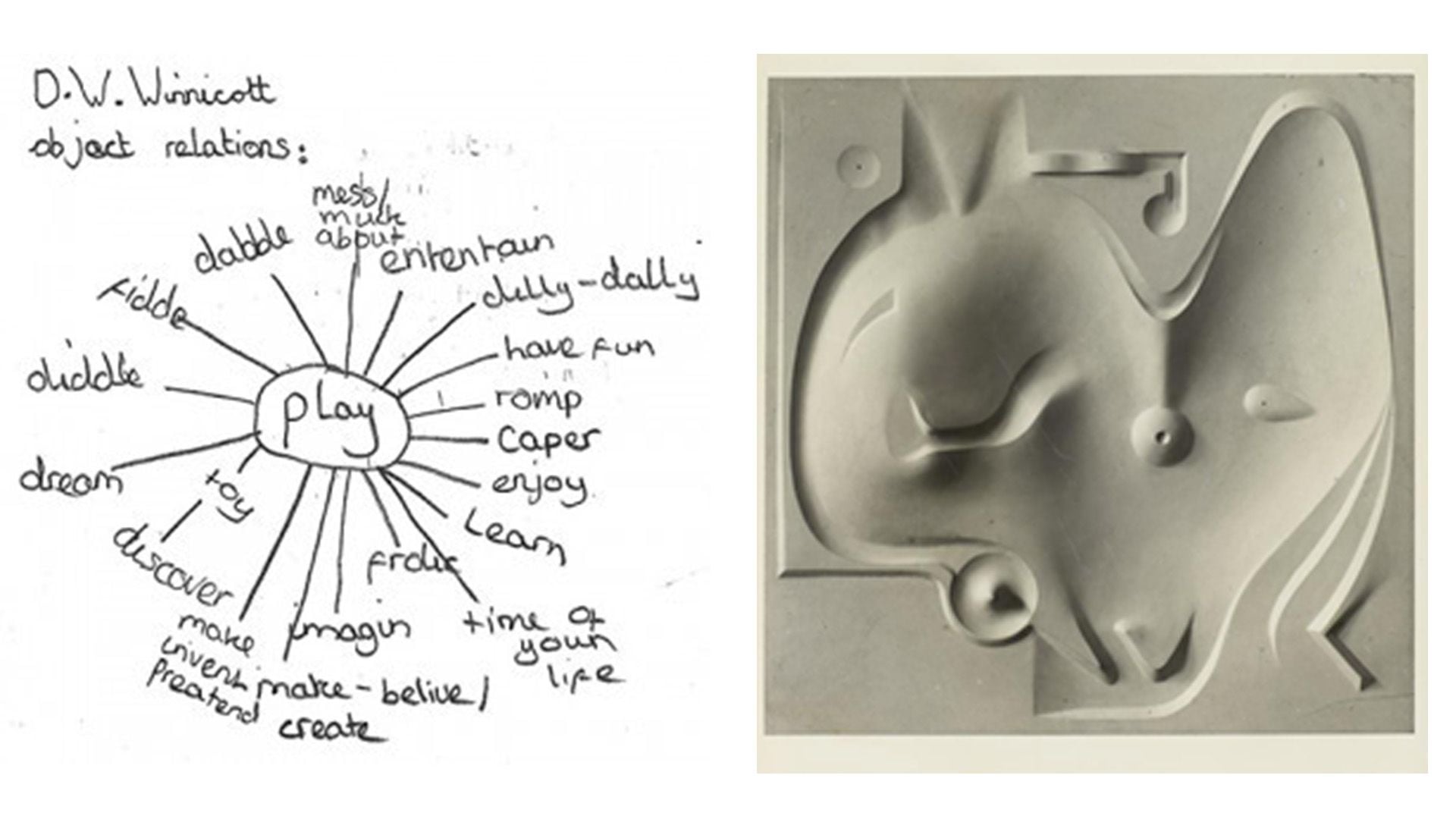
Images: D.W. Winnicott drawings and Isamu Noguchi, Contoured Playground, 1941
SCHEDULE
10:00am - Introduction: Doreen Bernath and Gabriela Jimenez
10:15am - Lorens Holm: Seminar on the Neighbour, Architecturally and Psychoanalytically Considered
11:00am - Gabriela Jimenez: The Play Field
11.45–12.00pm Break
12:00pm - Claire Potter: Kicked a Wardrobe Lately? The Lion, the Witch & the Transition
12:45pm - Discussion with Merce Rodrigo and all guest presenters
Guest discussant
Merce Rodrigo-Garcia is an architect and PhD candidate at Birkbeck College. After studying at the Bartlett School of Architecture (UCL), she obtained her MArch from Research Architecture Goldsmiths. She has taught at Oxford Brookes University, has been a fellow at Tokyo Institute of Technology, and has held residencies and participated in symposia internationally.
Guest presenters and abstracts
Lorens Holm
Seminar on the Neighbour, Architecturally and Psychoanalytically Considered
The neighbour is a contested figure. ‘Strong walls make good neighbours,’ said Robert Frost in ‘Mending Wall’ (1916).1 With respect to ethics, it goes back to Leviticus, and the commandment love thy neighbour as thyself. Etymologically, neighbour means near man.2 In Leviticus, it is love thy neighbour as thyself and leave your field edges unharvested for gleaning by the wayward indigent, love thy neighbour as thyself and pay your employees on time. The neighbour is a contingent category of other based solely on propinquity. It cuts across other social formations like race, class, genealogy, hobbies, politics, the PTA, and other interests, identities, and affiliations. As Kenneth Reinhard argues in The Neighbour: Three Inquiries in Political Theology, the neighbour disrupts the dichotomies of friend/enemy or friend/stranger, and father/tyrant/stateman (family/state/polis) and, following Lacan and Freud, raises the horrifying prospect of being made subject to the enjoyment of others. The neighbour is the stranger we have to live next to, whose interests and – more importantly – whose pleasures are different from ours. In The Ethics of Psychoanalysis, Lacan associates the neighbour with the drive, with the jouissance that is different from pleasure and lies beyond the pleasure principle, with the real of the Freudian Thing, and the self-aggression of the superego; and he associates the commandment to love thy neighbour as thyself to the absence represented by a God who has always already been dead. We might call it a rim figure, who comes to the subject of civilisation, from the psychoanalytic outside.3 This contested nature of the neighbour is most clearly recognised by architecture in the form of the party wall and party wall legislation. The party wall is part of the public infrastructure of the city that has extended itself into the domestic realm where everything is personal. In urban terms, the neighbour is the figure for our anxiety about the periphery. In this scenario, the construction of the city – what Rossi calls ‘architecture’ – is a compensatory activity – we build cities to compensate for our natural aversion to the closeness of the neighbour. And it is perhaps in the ragged peripheries of cities where this anxiety is most clearly exposed. Ethics is about how we live well together. This seminar will treat the figure of the neighbour as both an ethical and territorial category, which crosses ethical discourse of psychoanalysis with the spatial discourse of architecture. It will refer to Lacan’s Ethics and Mark Cousins’ public lectures on The Neighbour (2009-10).4 It will raise questions relating to how we occupy the surface of the earth, which is the underlying concern of architectural discourse.
Lorens Holm is a Reader in Architecture at the University of Dundee. He runs the architectural design research unit rooms+cities, which focuses on city morphology and artefacts. His written work focuses on reconciling psychanalytic thought on subjectivity with modern architecture and contemporary architectural and urban practice. In 2019, he organised the AHRA conference ‘Architecture & Collective Life’. Publications include Reading Architecture with Freud and Lacan: shadowing the public realm (2022), Brunelleschi Lacan Le Corbusier: architecture space and the construction of subjectivity (2010) and, with John Hendrix, Architecture and the Unconscious (2016). His papers have appeared in Architecture and Culture, Journal of Architecture, Perspecta, Critical Quarterly, and Assemblage. He is a founding member of iPSA, the institute for Psychoanalytical Studies in Architecture.
Gabriela Jimenez
The Play Field
The presentation considers how children play, what is beneath the act of playing at the subject's unconscious level and, importantly, how the influence of the setting, the playground creates the conditions according to which children's play. If we agree that play is not a stimulus-response activity or a conditioned behaviour that we can generalize or predict, following Winnicott, this paper will suggest that children play in a middle zone between what the ground affords and what the subject determines from this setting. Through Lacan´s optical schema, my argument will propose the idea of a playground as a ¨Play Field¨ in order to redefine play as an aesthetic encounter that allows play to unfold.
Gabriela Jimenez is currently a PhD candidate at the Architectural Association School of Architecture. She graduated from the University of Chile (2003) and holds a Master's in Architecture from the University College of London (2006). Her research interest is linked to the spatial conditions for play and their relation to the infant psyche. She has taught design studios and theory seminars and collaborated with different architectural practices in London and Chile.
Claire Potter
Kicked a Wardrobe Lately? The Lion, the Witch & the Transition
Inspired by the dark humour of Cornelia Parker’s 2016 photogravure, Coffee Pot Hit with a Monkey Wrench and by the fantastical wardrobe found in C.S. Lewis’s famous wartime novel, my talk will focus on the moment (if I can call it that) when a transitional object comes to stand in for the lost object. My argument will propose that this threshold moment might somehow be legible through the lens of architecture; that it carries something of the weight and experience of crossing a frame whereby the axis of the vertical and the horizonal – the upright and the passage, the wish and its fulfilment – come to meet in a chaotic and kaleidoscopic way as if we were to step inside a wardrobe with a monkey wrench …
Claire Potter is author of two books of poetry, Swallow (2010) and Acanthus (2022) as well as chapbooks, In Front of a Comma (2006) and N'ombre (2007). Her poetry has been short-listed for numerous Australian literary awards, translated into French and Chinese and has appeared in London Review of Books, New Statesman, Poetry Ireland Review, Poetry Chicago and the New York Review of Books amongst others. She received a French Embassy scholarship to complete a Masters at Paris VII in psychoanalysis and medicine before further studies in Infant Psychoanalytic Observation at the Tavistock London. Prior to living in London, she lived in Paris for a number of years working as a translator, teaching language and critical thinking at Sciences Po and Parsons. She currently teaches at the Architectural Association where she runs the AAWriting Centre, connecting architecture with writing. She has published widely on the work of Luce Irigaray and her research interests lie at the intersections of literary space and writing, psychoanalysis, feminist art practices, architecture and diagrams.
Find out more about the other events in the series Desiring Transitionality - Dream and Desiring Transitionality - Transit
1 Poetry Foundation website, https://www.poetryfoundation.org/poems/44266/mending-wall, accessed January 2023. From The Poetry of Robert Frost by Robert Frost, edited by Edward Connery Lathem. Copyright 1916,… 1970.
2 Old English. The German is neben-mensch, or near man. As Cousins points out, in Romance languages, it is usually rendered the next (man), which suggests another field of connotations.
3 Jacques Lacan, The Seminar of Jacques Lacan, Book VII: The Ethics of Psychoanalysis 1959-1960 (NYC: Norton, 1986/1992) transl. by Dennis Porter, ed. by Jacques-Alain Miller.
4 See the Mark Cousins Lecture Archive for the lecture series ‘The Neighbour’ <https://www.aaschool.ac.uk/markcousins/34>