Everything Architecture
Everything Architecture
28 April 2017
Time
6.30–8pm
Location
Lecture Hall
All of my art has been premeditated: having a notion of the end and not the means to the end. The means to the end has always been secondary in my art. It’s the end product that I’m after.
- Ed Ruscha
In various conversations in relationship to his own work, Ed Ruscha described his work as premeditated, having a notion of the end product, but not (yet) of the means to the end. Seldom has an idea of intentionality in cultural production been more pointedly described.
Our architecture is premeditated, it is fully aware, it is (only) interested in the end product. As it is convinced that only the project as a whole, fully executed, ‘finished’ (whether on paper or in stone) is able to engage with the world and thus able to take a stance in relation to it.
Engaging with the world is what architecture should do, it should carry the flag of culture in defiance. For more than a decade our office has been making architecture, always with awareness and obsessively precise.
It was, and is, convinced of its goals, though it is simultaneously unable to define them. This is the core of cultural production.
The world today is both interiorised and urbanised, everything is built, but (almost) nothing is architecture. In such a context, the only context we have – a veritable ‘even covered field’ – we need to understand how we can define a minimum of comfort, a commons, a set of anchor points, a space to live, a connection with our cultural traditions. The architectural tradition is both vast and concentrated and cannot but re-negotiate the principles and elements that have been re-appropriated for eras prior to us. Still, that same negotiation happens in our contemporary world, it is a world were everything is known and secrets are hard to keep; information is broadcasted 24-hours a day and almost nothing is read, or understood.
In this world of extreme availability selection is what we should most caress. In our age saturated by social media, cutting, accumulating, appropriating and selecting is the core of our contemporary classicism.
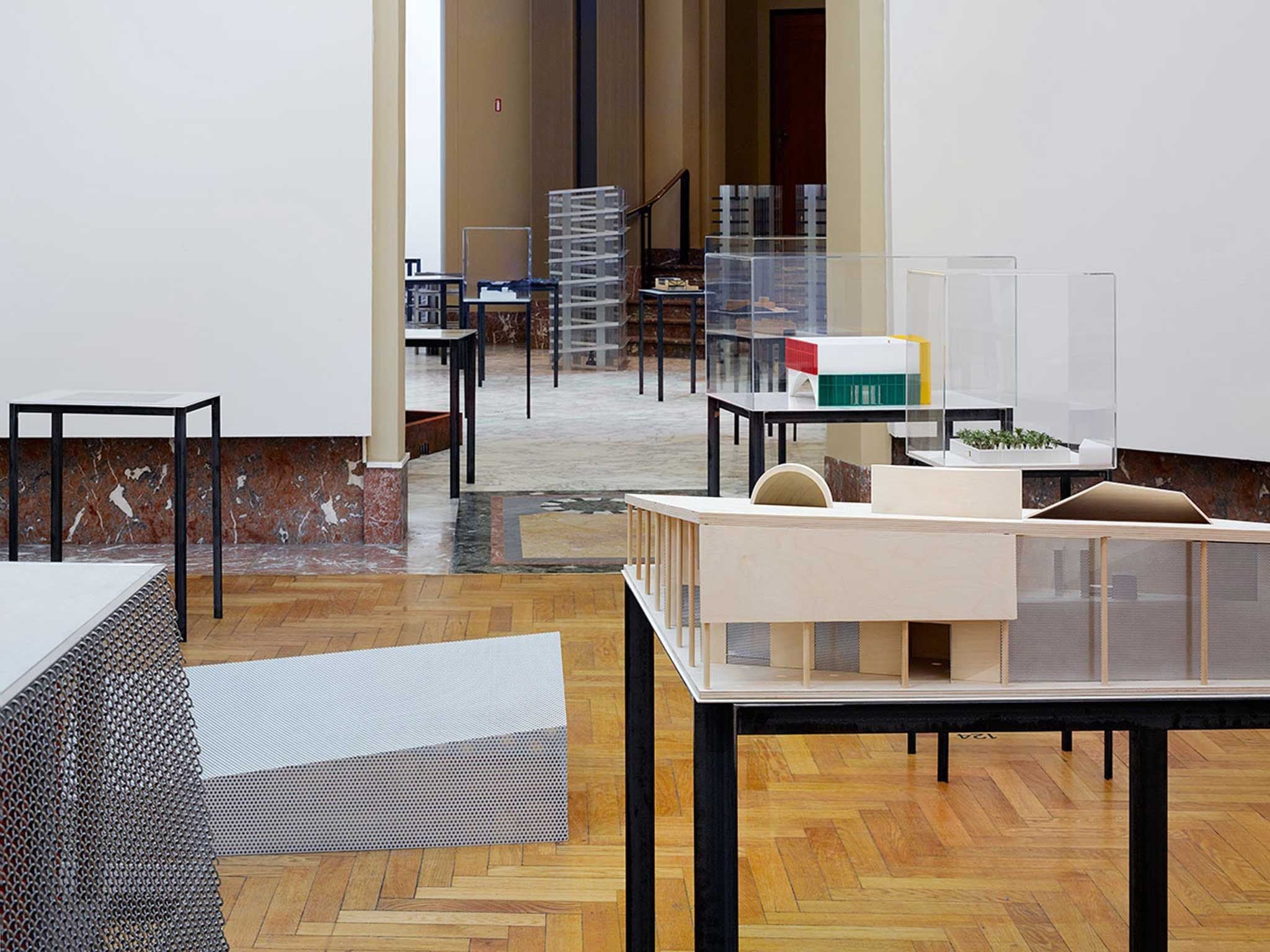
Everything Architecture shows almost nothing, but that which it shows is very important for us: It is everything we consider ‘architecture’ today, so to speak, up to the current point. At the centre of this argument we position a family of projects, a set of tables with models. Almost all models are final, despite their uneven materiality, they all served in a moment of ‘presentation’.
The models provide a perfect antidote to the other material that is included in the show: perspectives, photographs, paintings, objects and sculptures often not by the office, but integrally part of its universe. What is architecture, other than a device to define spaces, a tool to make hierarchies, a machine for illusions, an element for reference? Architecture is limited but all inclusive. It is performing in relative autonomy, it engages in that what it contains without ever being infected, without being involved in the process.
Everything Architecture shows everything chosen, everything framed, everything selected, everything depicted, everything shown. The show is everything, and as a consequence everything else is not. Only through careful selection we will survive the noise of our times.
Kersten Geers (Ghent, 1975) graduated in Architecture and Urbanism at the University of Ghent, Belgium and at the Esquela Tecnica Superior de Arquitectura in Madrid, Spain. He worked with Maxwan Architects and Urbanists and with Neutelings Riedijk Architects in Rotterdam. He was professor at the University of Ghent, visiting professor at Columbia University, NYC, and the Academy of Architecture in Mendrisio (CH), and is currently teaching at the EPFL, Lausanne (CH), Harvard Graduate School of Design (US) and Yale Graduate School of Design (US). He is a founding member of the architecture magazine San Rocco, and frequently publishes essays on architecture in a variety of magazines and books. In 2002 he founded Office Kersten Geers David Van Severen together with David Van Severen. In 2008 they were awared with the Belgian Prize for Architecture and in 2010 with the Silver Lion at the 12th Venice Biennial of Architecture.
David Van Severen (°Ghent, 1978) is founding partner of OFFICE Kersten Geers and David Van Severen. He graduated in Architecture and Urbanism at the University of Ghent, Belgium and at the Esquela Tecnica Superior de Arquitectura in Madrid, Spain. Until 2004 he worked for Stéphane Beel Architects in Ghent, Xaveer De Geyter Architects in Brussels and for Atelier Maarten Van Severen. He has been a teacher and guest critic various international schools, and is currently teaching architectural design at the Academy d’Architecture, Versailles (FR) and Harvard Graduate School of Design (US).
Image credit: Bas Princen.
Supported by the Government of Flanders