For a Critique of the Architectural Image, Session 1 : Orthogonal Projections
For a Critique of the Architectural Image, Session 1 : Orthogonal Projections
5 October 2022
Time
10am–12pm
Location
No. 33 Bedford Square, First Floor Front
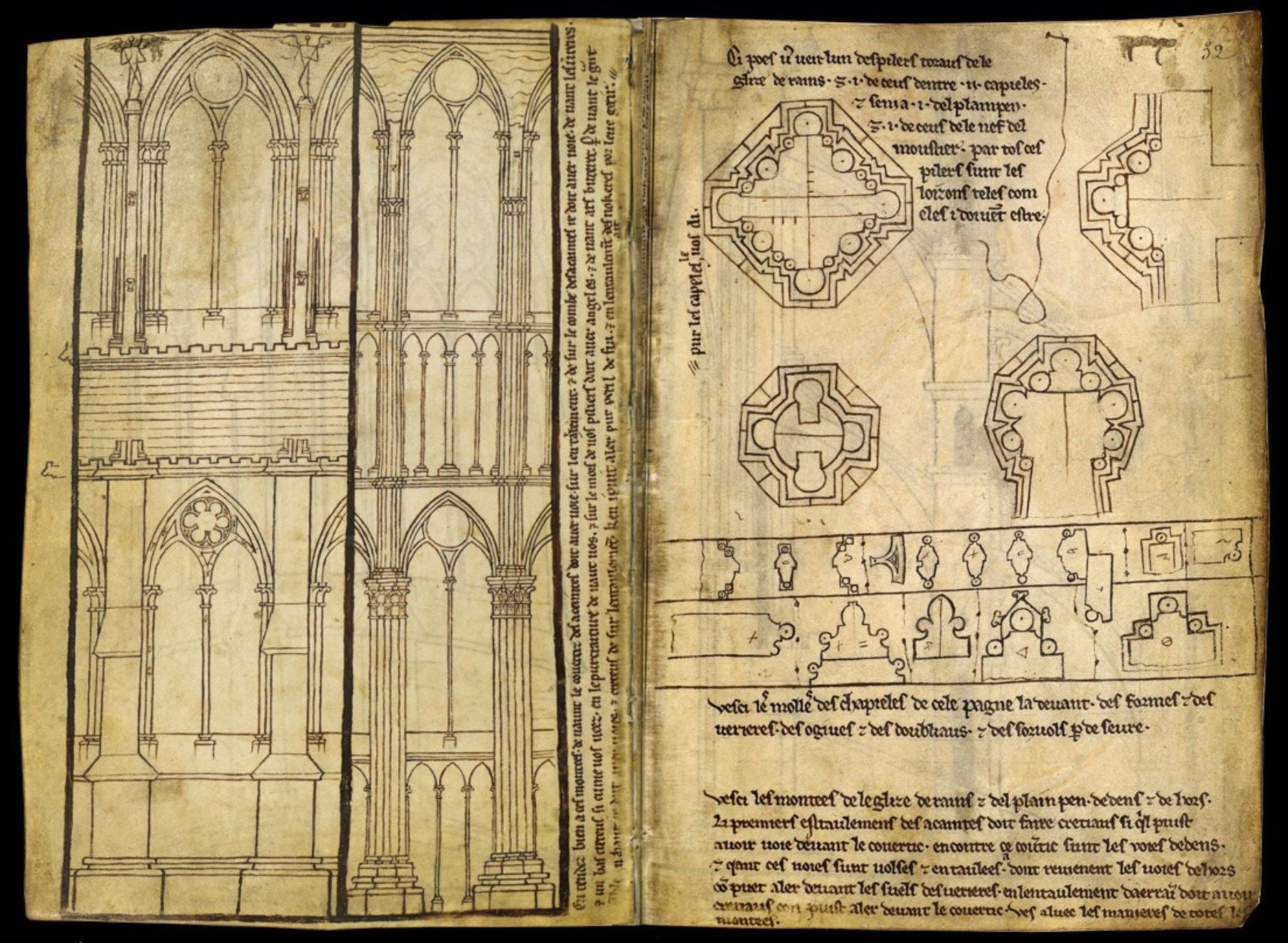
In the 1230s, Villard de Honnecourt drew in his notebook an elevation that depicts both the internal and the external façade of the Reims cathedral. This is one of the first extant examples of modern orthogonal projections; in the moment the architect emancipates himself from craft guilds, drawing becomes a key tool for the construction of a new form of knowledge. The session will depart from Villard’s work to analyse other early cases of the emergence of orthogonal projection as working tool for medieval architects. The façade is the locus that registered the displacement of the master mason at the hand of the architect-intellectual, but it will be the plan, from the XV century forward, that will become the primary device for the organisation of life in a building. The development of the plan as technique corresponded with an increasing attention towards movement, circulation, and function that brought architects to develop rudimentary ‘distribution’ into fully-fledged typological thinking. Above all, the plan is the instrument through which the modern architect defines himself as curator rather than craftsman.
Image: Page from the sketchbook of Villard de Honnecourt
To join this talk remotely, please email: Maria.Giudici@aaschool.ac.uk