Future Rural: Casting a non-Western gaze on the rural-urban dichotomy
Future Rural: Casting a non-Western gaze on the rural-urban dichotomy
17 November 2023
Time
10am–6.30pm
Location
AA Lecture Hall
Money is made in cities. Wealth is accumulated in cities. Rural communities get left behind. Japan is no exception: the country has been suffering from rural depopulation since the 1970s; spearheading the global trend.
In the latest findings shown by Japan’s Ministry of Internal Affairs and Communications, more than half of the towns and villages in Japan are suffering from depopulation. The situation is compounded by the ageing population in Japan. Current research suggests that the world’s rural population is predicted to fall from the current figure of 47% to 30% by 2050.
One of the UN’s Sustainable Development Goals states that there must be a balance between urban and rural environments, “because only then can greater sustainability in all such environments be achieved.”
Following on from the exhibition, “The Future is Rural,” curated by Yuki Sumner for the London Design Biennale in June 2023, this symposium will showcase artist-led activities and grassroots initiatives aimed at revitalising rural Japan and beyond.
The symposium will also present research being conducted in parts of rural China, Mongolia and Pakistan, highlighting some of the tensions that exist between urban and rural conditions in these contexts, as well as the challenges that rural communities face, where they often have to deal with forces much bigger and more powerful than them.
The whole event will question what the best approach could be when readdressing the structural imbalance that exists in the relationship between the rural and the urban.
Schedule:
10:00 Welcome by Yuki Sumner
10:10 Illuminating Japan’s new rural by Christian Dimmer
Case studies – Part I
10:30 Presentation by Junko Kunihiro
10:45 Presentation by Kyoko Wainai
11:00 Q+A with Christian Dimmer, Junko Kunihiro and Kyoko Wainai
11:45 Coffee Break
12:00 Keynote: Creating a forest inside an office in the suburb of Nagoya by Tomoaki Uno
12:40 Q+A with Tomoaki Uno and Yuki Sumner
13:00 Lunch Break
Case studies – Part II
14:00 Presentation by Tatsuya Tanaka
14:15 Can rural be the intermediary between urban and nature? : Panel discussion chaired by Ruth Lang with Tatsuya Tanaka and Alice Edgerley
15:00 Coffee Break
Illuminating new rural Asia
15:20 Film screening – Milaap: where the sweet water meets salt water with an introduction from Marvi Mazhar
15:35 Presentation by Kent Mundle
15:50 Presentation by Jingru (Cyan) Cheng and Chen Zhan
16:05 What are the particularities of rural conditions in Mongolia, China and Pakistan? : Panel Discussion chaired by Shin Egashira with Marvi Mazhar, Corinna Dean, Kent Mundle, Jingru (Cyan) Cheng and Chen Zhan
16:45 Coffee Break
17:00 Keynote: Establishing the Small Earth community in rural Chiba by Yoshiki Hayashi
18:00 Q+A with Yoshiki Hayashi and Takeshi Hayatsu
--
Speakers include:
Jingru (Cyan) Cheng and Chen Zhan collaborate on a transdisciplinary project RIPPLE RIPPLE RIPPLING. Cheng is currently the Harvard GSD Wheelwright Prize Fellow and teaches at the Royal College of Art. Zhan is an architect, anthropologist and independent filmmaker based in the UK and China.
Corinna Dean is a London-based architect and
academic. Dean is co-recipient of a British Council award titled Gender
Ecologies, which explores the intersection
of women, climate change and arts. She is an
active ecologist blending arts, ecologies and making.
Christian Dimmer is Associate Professor for Urban Studies at Waseda University in Tokyo. Originally from Germany, Dimmer lives in Tokyo and teaches courses on Transition Design, Urban Commons, Theories of Placemaking and Urban Practice (commonly known as Planning Theory).
Alice Edgerley is a London-based architect from the design collective Assemble, who was one of three from Assemble to visit Kamikatsu village to work on the design of a beer-tasting hut for Mr Tanaka’s new venture in the village.
Shin Egashira is a London-based Japanese architect and Diploma 11 Unit Master at the AA. Egashira has been conducting summer workshops for international architecture students in the rural village of Koshirakura, Niigata every year since 1996.
Yoshiki Hayashi founded a non-profit organisation called Small Earth in Kamogawa, Chiba. The Small Earth community is set up largely to preserve the traditional farming landscape called Tanada and knowledge and skills passed down through generations in this region.
Takeshi Hayatsu is a London-based Japanese architect who founded Hayatsu Architects, following a period at David Chipperfield Architects and 6A architects. Hayatsu teaches architecture at Kingston University.
Junko Kunihiro is an ex-banker-turned-architect-turned-town manager. Kunihiro worked with Sambuichi Architects in Hiroshima before leaving to work in China, where she became interested in town planning. Kunihiro now works closely with local councils to revitalise areas within Tokyo, such as Ome and Ikebukuro.
Ruth Lang is a London-based architect. Lang teaches at the Royal College of Art and the London School of Architecture. She is author of Building for change: The Architecture of Creative Reuse, published by Gestalten in 2022. Lang is also currently lead researcher in Low Carbon Housing in the Design Museum’s Future Observatory.
Marvi Mazhar is a Karachi-based architect. Mazhar has created a documentary film in collaboration with Zohaib Kazi (filmmaker) and Abuzar Madhu (performance artist) as part of Gender Ecologies programme funded by the British Council. Mazhar’s film is about a visual investigation into the significance of land and water protection in times of climate crisis.
Kent Mundle is an architect and lecturer at the University of Hong Kong. Mundle was part of Rural Urban Framework, co-founded by Joshua Bolchover and John Lin, from 2020 to 2021. Bolchover’s book “Becoming Urban: The Mongolian City of Nomads” was published by Oro Editions in Sept 2023.
Yuki Sumner is a London-based journalist, critic and curator. Sumner has a master’s degree in Architectural History and Theory from The Bartlett, UCL. Sumner makes regular contributions to magazines worldwide as a freelance reporter and critic, she produced, edited and co-authored New Architecture in Japan, published in 2010, and curated “Future is Rural” for the London Design Biennale 2023.
Tatsuya Tanaka is a businessman who helped to launch Kamikatsu village in Tokushima as Japan’s first zero waste town. He has collaborated with prominent architects, such as Assemble and Tokyo-based architectural practice Hiroshi Nakamura & NAP, to put the village on the map.
Tomoaki Uno is founder of Tomoaki Uno Architects, based in Nagoya, Aichi Prefecture. Uno set up his own architectural studio in 1990 and has an impressive portfolio of one-off houses. He works closely with artisans. Sumner visited the office Uno designed during her research trip to Japan in 2022 and wrote about it for Wallpaper* magazine.
Kyoko Wainai is a designer and activist who recently moved back to Japan after living in London for 30 years to launch Life laboratory TOHOKU in Misato, a rural town in Tohoku, providing a hub for the local and international creative communities. Wainai collaborates with a number of international brands and is a creative advisor for the Royal Tarayana Foundation in Bhutan.
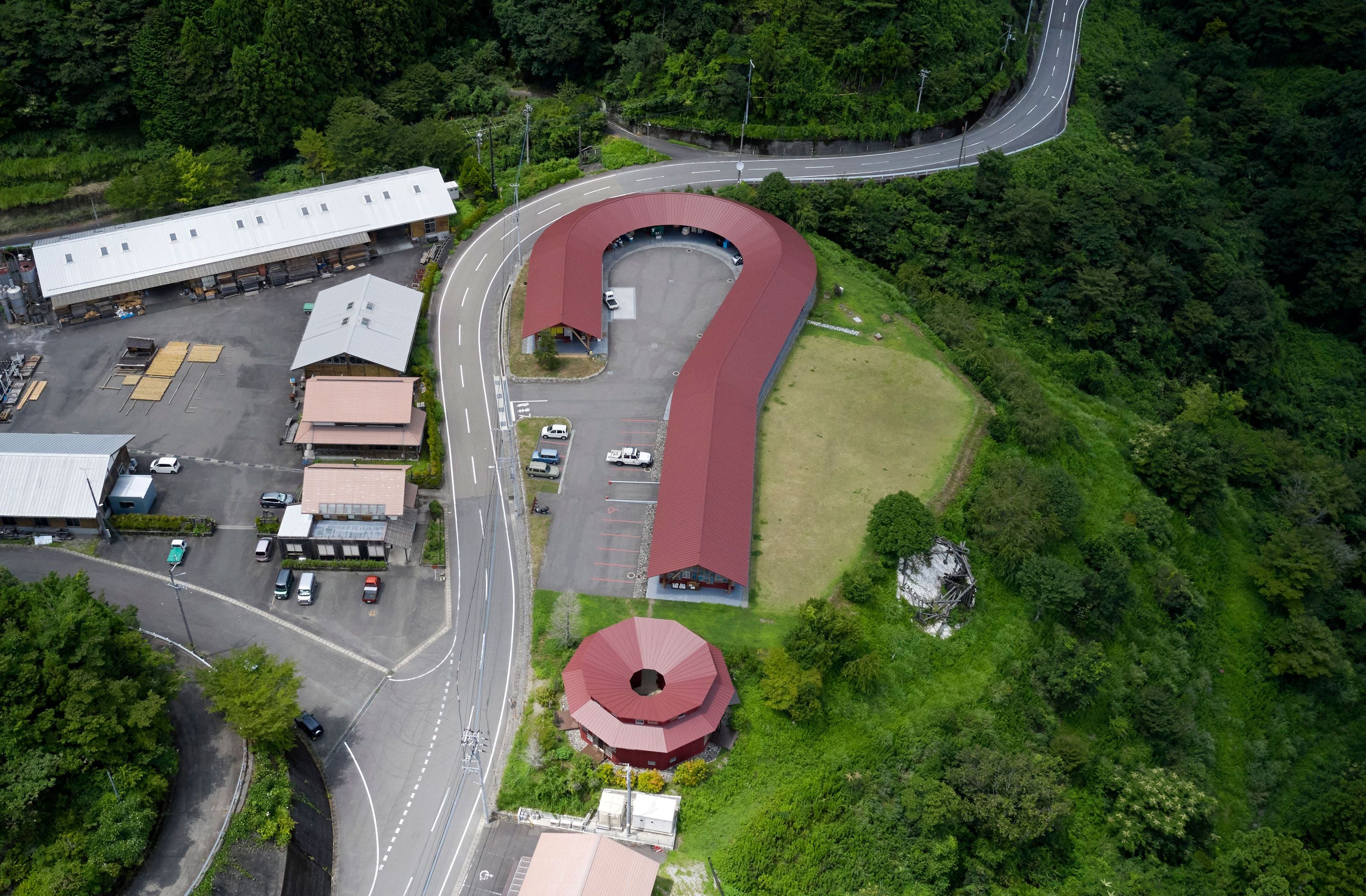
Image: An aerial photograph of “Hotel Why” in Kamikatsu Village, Japan’s first Zero Waste Town, in Tokushima, Japan © Edmund Sumner
This event has been supported by TOTO