Table Talk: Three Courses of Education
Table Talk: Three Courses of Education
22 February 2024
Time
6.30–8pm
Location
Front Members' Room, 36 Bedford Square
The lecture format undoubtedly represents a valuable and efficient model for how many individuals can learn from another. One person (or perhaps a small group) has something to say, and lots of people listen. Ideas are distributed evenly to each participant, which is equitable. But a hierarchy of power is established in doing so, which isn't.
Often the content of a traditional lecture is processed and challenged in private, between colleagues or friends. But what if the speaker were as interested as hearing from you as you are from them, and placed in a setting where the typical hierarchy established by their position behind the lectern is dissolved; somewhere convivial rather than formal?
The vast majority of architectural learning is still conducted as if the discipline at large operates as it did half a century ago, which it does not. But building anything in the UK today is an entirely different ballgame to doing so even 20 years ago, and the way that we think about the city and how it is developed has changed. So something has got to give.
Design processes have evolved to reflect the complexity of economically and socially sustainable construction, as well as to enshrine practices that increase levels of equality, accessibility and inclusion in both public and private procurement routes. This pace of change in the profession, however, has arguably not nearly been matched by academia.
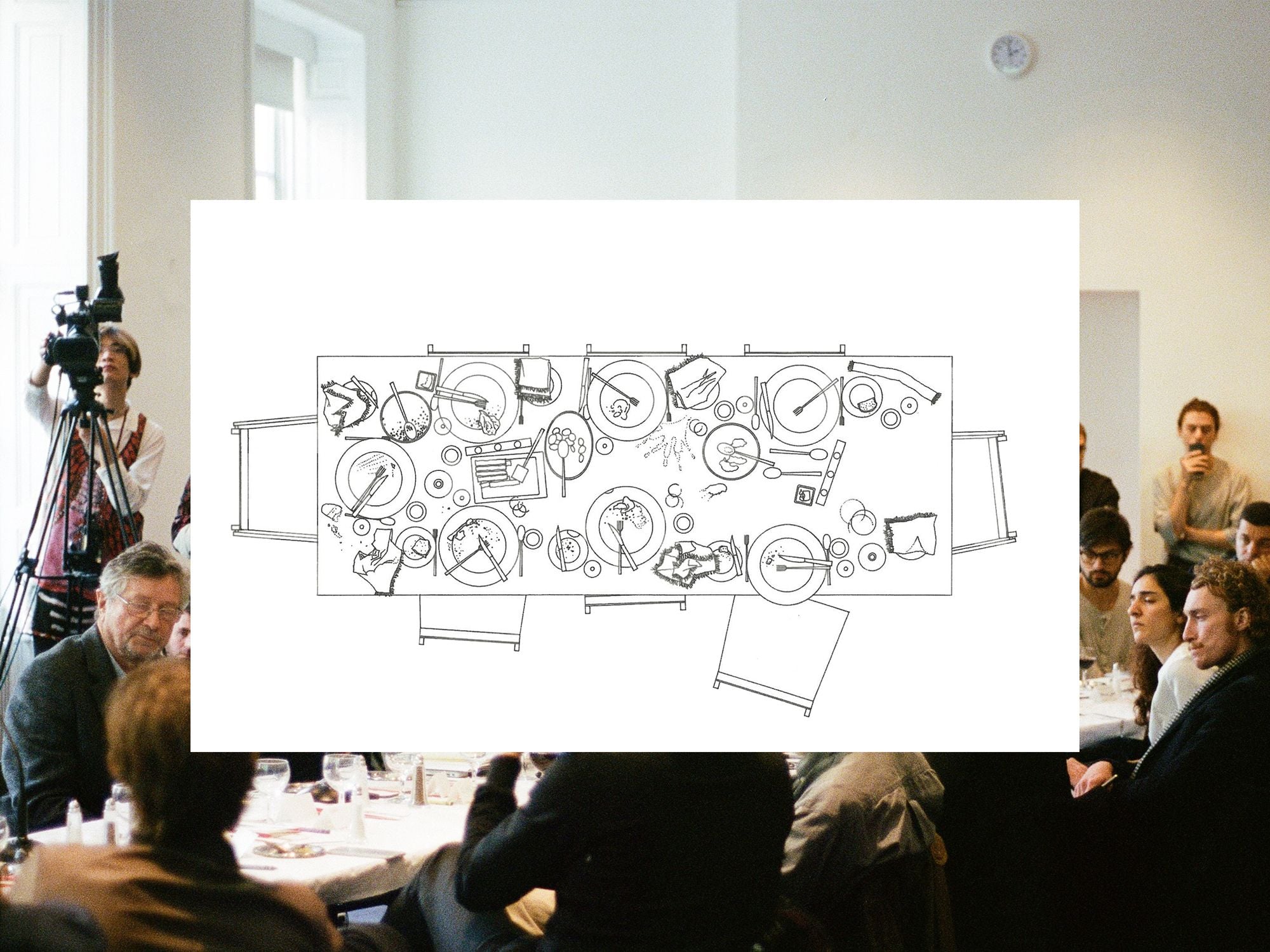
For this event, Jeremy Till will discuss his ideas about the changing nature of architectural education over a three-course dinner. Taking place around a shared table at the AA, the conversation will be multi-directional rather than binary, and participants and speaker will meet each other at eye level to discuss, challenge and develop on the themes raised.
Jeremy Till is a writer, educator and recovering architect. As a writer he is best known for the book Architecture Depends. As an educator he was Head of Central Saint Martins UAL where he is now Professor of Architecture. His current research project with the collective MOULD is called Architecture is Climate.
Please get in touch to let us know of any food allergies or dietary requirements that you have and how we can best accommodate these at publicprogramme@aaschool.ac.uk
Self-Organised: Models for Learning is a series organised by Leela Keshav, Francesca Romana Dell’Aglio, Rory Sherlock, Sharvaree Shirode, Abhishek Wagle and Francesco Zuddas.
If it is a truism that learning is hard work, this is not merely because of the complexity of certain topics or subjects to be learnt. More generally, learning is a difficult social practice, the hard to achieve balance in a dialogue between individual idiosyncrasies and collective aspirations. The image of the lone scholar in their studiolo necessarily depends on a counterpart of groups that are constantly forming and disbanding from within, but also often set against, the institutional set-ups of education. This events series explores the multi-faceted relations between institutional education and its many possible others that take the form of self-organised, collaborative models conceived and run by that vast, chaotic, and contradictory group that we call learners. Bridging between inside and outside of the AA and its institutional yet quasi-domestic spaces, the series makes use of different formats – from peer reviews to walks, dinners to co-design workshops – to trigger discussion, raise hope, but also accept frustration, on the current predicament of architectural education and what constitutes a learning environment that can set itself apart from the prospect of a bureaucratised and commodified model solely shaped from the top-down.
The Self-Organised: Models for Learning event series accompanies the exhibition on show in the AA Gallery titled Warburg Models: The Architecture of the Itinerant Archive, open from 19 January to 7 March 2024.
Image: Sarah Wigglesworth