Matthew Lloyd Roberts: Patricia, thank you so much for joining me today. I was wondering what inspired you to set up this scholarship for young architects at the Caribbean School of Architecture, University of Technology, Jamaica?
Patricia Green: First of all, it is a celebration of my life, and as a woman of faith I have been blessed tremendously. As a student I received a government scholarship to go and study architecture at the AA, and I have been Head of School at the Caribbean School of Architecture. I am aware that there are many students who are unable to finance their studies, many brilliant students who are having difficulty concentrating on their studies because they have issues with finance.
In looking back on my anniversary as a practicing architect, I remember coming back to Jamaica after my studies in London in October 1980. Jamaica was in a very turbulent way in the 1980s, and having graduated from the AA, almost without exception, every friend and family said, do not return to Jamaica. So before that I bought a book called Europe on $10 a Day and packed my rucksack. I traveled from London for three months alone, I only spoke English and I went all the way across Europe. I thought, if anybody offered me a job, I would take it. That didn’t happen, so I returned to Jamaica on the day of the election, 30 October 1980. I couldn’t vote in that election, so that ticket to return home was my vote. When the 40th anniversary of that date came, I wanted to mark all those years that flew by so quickly, so I marked it by setting up the scholarship.
I wanted the scholarship to go to a female architect, to encourage women in architecture, because two thirds of the students at the University of Technology, Jamaica are male. It was my 40th anniversary so I chose a fourth year student, and therefore $400,000. A scholarship committee was formed by the Dean, and we shortlisted three candidates and the scholarship was won by Shimeika Brown, who is just so brilliant. She had been self-financing her studies so it made a huge difference to her, I am so delighted.
Matthew: When you started your studies, what was life like at the AA?
Patricia: I arrived at the AA in 1972, my studies were supported by a scholarship from the Jamican government. The AA was very high on the agenda for the education of Caribbean people in those days because there was a course called Tropical Architecture, taught by Jane Drew and others, although it petered out just as I arrived! Although I did meet and worked with Paul Oliver whilst I was at the AA, and we subsequently became friends, and I wrote four chapters for the Encyclopedia of Vernacular Architecture of the World which he edited in the 1980s. It is important to remember that 40 years ago, the architecture of my home, the built environment of the Caribbean, was considered folklore, it wasn’t called ‘Architecture’ with a capital ‘A’ OR with a lower-case ‘a’! That Encyclopaedia, and the conferences in the 1980s that produced that research, was incredibly important for moving the study of the Caribbean built environment into the world of architecture.
When I was growing up it was a very turbulent time for young people from my background: we were cutting our hair and getting afros and listening to soul music and following Miriam Makeba and Angela Davis and Rastafarianism. I remember in high school using the scissors in the biology lab to cut my hair, and my grandmother weeping when I came home. So I started at the AA in 1972, which was the same year as Zaha Hadid, and even today my students will ask “did you really go to school with Zaha Hadid?” I remember they used to call me Sunshine because coming from Jamaica I didn’t know that you don’t wear bright red pants in the middle of winter. I would always wear bright red and green and polka dots, whenever I walked in the AA Bar I would find everyone, including Zaha, wearing dark brown or black, usually with all these furs round her neck, and you could always tell when she was around because she wore the most expensive perfume, everywhere she walked she left a scent. She never knew my name but she used to say “Hello Jamaica!” because of my clothes.
In that season, when so much was happening, I was joined by another Jamaican colleague Mark Taylor, and subsequently there were lots of other students from all over the Caribbean as well. The AA in those days was quite radical, you didn’t know what you were going to be doing. My first unit was with, I think his name was William Grimmer? We went to Wales, to fix up an old house! Imagine leaving London in the middle of winter, travelling to Wales with a backpack and living in a house which had no floorboards, no heating, no internal plumbing. The house was in a mining community near Port Talbot, and every evening after working we would go to the pub and stay there because it had running water and an electric heater, we learnt to play billiards, then we went back and slept in the house and got up in the morning to continue the work. That’s how we lived for three months, an entire semester. So I started by doing real, practical, hands-on, community-based work. And now I’m talking about it, I realise why I am the way I am, because that was my foundation in architecture, working with the community. We went into people’s homes, we looked after their babies, we looked at their houses because we were architecture students, we went to the pub, we went down the coal mine, we were there when people were injured.
Matthew: It is an amazing image, you working to repair this house, being part of this mining community, did it feel very strange for someone who had grown up in Jamaica?
Patricia: You have to understand, you know, I am black. I didn’t know I was black until I came to study in the UK. I remember going to a cafe in London with a friend and he was given his food on a plate, and I got mine wrapped up in plastic with a paper cup. And my friend said: “We’re leaving.” And I asked why? And he said “Come on we’re leaving.” And years later he explained that he left because they discriminated against me, they didn’t want me using their plates and glasses, but I didn’t know at that time! I remember children following me in the street saying “little blackie Sambo” and I wrote to my parents and my father said don’t you remember the book we used to read you. I learnt three important lessons working on that project: 1. Working with the community 2. Weather! Because going to Wales from Jamaica was quite a shock 3. Lots of people don’t know any black people.
But London was not a bad experience, I went on to study in the US and found the racism there something else entirely, which still exists today. I got a scholarship to study Historic Preservation at University of Pennsylvania, which was a very small course when I took it but now is a brilliant programme with lots of graduates. I went on to take a PhD in Architecture, Heritage and Preservation at the University of Seville.
Matthew: You’ve mentioned this problem of architecture with a capital ‘A’, and obviously a big part of that is that the teaching of architectural history has often excluded architecture built by some cultures, and paid attention to others, like the architecture of European empires. How do you approach the Eurocentric way that people over time have thought about architectural history?
Patricia: You don't need to skirt around it, many architectural historians called our architecture primitive. They called it folklore. If the architectural heritage of a nation was not based on Palladian style, or Victorian Renaissance, it was described as folklore. And it did not fall under the study of architecture, it fell under the study of Human Geography. I don’t think we thought about it purely in terms of race, but it certainly was Eurocentric. In those days our education was entirely about Europe and the UK. I dropped history at school, I did a geography A Level instead, so we learnt about Europe, we learnt about the British Empire, we learnt about all this wonderful architecture. It enticed me, I was excited, I wanted to learn and see and feel and touch, which I did.
I went on all these excursions, to country houses and palaces, and I’m learning later that all of them were built by slave owners, they were built on the profits of slave plantations in the Carribean. At times I felt distressed, I thought, wow, this wealth was gained on the backs of the enslavement of my own ancestors. That was part of a learning process, and since that time Caribbean scholars have emerged who write about the Caribbean from a Caribbean perspective, and there was a big gap in the scholarship there, the books had all been written by European scholars. I imagine that Zaha had a similar experience, with a lack of scholarship or attention being paid to the architecture of the Middle East and Asia. Today we’re speaking much more about those parts of the world outside Europe, but in those days there was just ‘Architecture’ with a capital ‘A’, Graeco-Romano, Palladianism, and all that would be studied was the architecture of the great houses and churches in those other parts of the world. That was just how architecture was thought about.
Matthew: When you were studying at the AA, what units were you part of, do you remember any teachers in particular?
Patricia: My final year was with David Shalev, with whom I did work on the paintings of Giorgio De Chirico. I was also in Bob Evans’ unit as well. I encountered one of my Technical Tutors, Pedro Guedes at a conference in Australia, and he came up to me and said: “Are you Patricia Green from the AA? I was your technical tutor!” We’ve been working together on a couple of projects subsequently, looking at the preservation of military architecture. During my time at the AA, there were two trends among the units: either you were a constructivist/deconstructivist; or you were going to get to the heart of architecture. So with David Shalev we were thinking about the soul of the building and getting very esoteric. You’d stand up and wax lyrical about the character of the spaces and the columns, you’d design a room where you could lie back and look at the sky and think about these higher things. I’ll have to dig out my portfolio and see if I can find these projects. I was always trying to link my work back to my environment and my cultural norms, connecting my work to the community where I grew up. After my first three years at the AA, I came back and worked in Jamaica for a year, which helped with my thinking about these questions.
One of the things the AA always prided itself on is being international. Now my friends and colleagues always called me “The Traveler”, because every chance I got I went on a trip. We spent a month in Egypt and went to Hassan Fathy’s workshop, thinking about mud architecture, building with earth in a tropical climate. At that time I also discovered a cousin who was living in Algeria and working in Corbusier’s office, assigned to work on a housing scheme in Algiers. Myself and another student, Carol Shields, went to visit and we went to the desert. I wore a head covering with just my eyes showing. We learnt about working with mud brick and slept on the roof and used a hole in the ground as a toilet. I argued with my cousin because he was building all these apartment buildings where women have no spaces. He responded that they shouldn’t shut the women inside. He didn’t understand, but I did because I had lived with the women when we stayed there. It is the men who do not have access to the house, they stay on the streets, whereas the women cross between households by walking on the roofs and visit each other. And he was building these tiny two bedroom apartments with a little awkward balcony, not respecting the social norms of the community who were going to live there.
Matthew: You had these incredibly rich experiences during your studies, how did they go on to shape your work and your thinking about architecture?
Patricia: I returned to Jamaica, where I practiced as an architect and also researched the history of Caribbean Vernacular Architecture, a term which I coined, but was rejected by the editors of several journals in those early days. I was always thinking about the connections between community and architecture, as my training at the AA had taught me. I worked for the government of Jamaica as an architect, and was invited in the 1980s to become Chief Architect, I would have been the first woman appointed to the role. They refused to give me the car that came with the job, the house that came with the job, they said that I am a woman and I couldn’t live in a house by myself, I had to live in a house with my father. There were many projects that I asked for, and never got them. I was assigned to the ministry of security, and I worked with police stations, and prisons and courthouses. That’s how my career in preservation began, because so many of these institutions were based in historic, Palladian, colonial buildings. Many additions and changes were being made to these buildings, and I had to stop them and say, that’s part of our architectural heritage! I was travelling all around the country, taking photographs of this rich architectural heritage, going off the beaten track, assembling a collection that summarised Jamaica’s history.
That came from my teaching at the AA, I remember history lectures with Sam Russell, he had a very monotonous voice so you had to keep yourself awake for those early morning classes, and he would talk about Primitive Hut and Rykwert and Laugier. On the other hand you had Charles Jencks, who was extremely energetic, tall and skinny, jumping up and down all over the place, talking about post-modernism to a huge crowd. Those lectures gave a direction for my practice, I went after projects to restore historic buildings, no money in it, but there were so many people looking to demolish and build something from scratch, and I fought hard to retain and restore and refit all these buildings. I went and did my PhD in Seville on these questions, and I’ve been trying to constantly publish and produce research addressing the under-researched history of the built environment in the Caribbean.
As these questions became more important, as people started to pay attention to the architectural heritage of the Caribbean, and funding was made available, UNESCO brought in consultants from all over the world to advise on these questions. I had to ask, why are all these experts being brought in only to use the research that I had spent years working on! I harassed them until they included me as a consultant on that project. I think that was part of the spirit that I learned at the AA. Every year when I was a student the school was threatened with being deregistered as a school of architecture, and it made us all very activist, very politicised, very radical.
I still have that streak in me when I’m dealing with heritage groups in Jamaica, they are often very keen to say that a building is Georgian or Victorian, and I’m always there to say that no, this is an African building, that the Aboriginal and African cultures of the Caribbean shaped its built environment. And I meet people who say that these buildings are slavery buildings, they should be demolished, that we gotta mash ‘em up. And I say to them, no, these buildings are fi wi, which is Jamaican for ‘ours’, it is our heritage, they were built by our ancestors.
I’m still in touch with many people who I met whilst at the AA, and there has been so much more of a dialogue over the course of my career about writing an architectural history that is more inclusive, that isn’t just concerned with architecture with a capital ‘A’. As a woman of faith, I hope that we will continue this struggle, and that we can all continue to learn from each other.
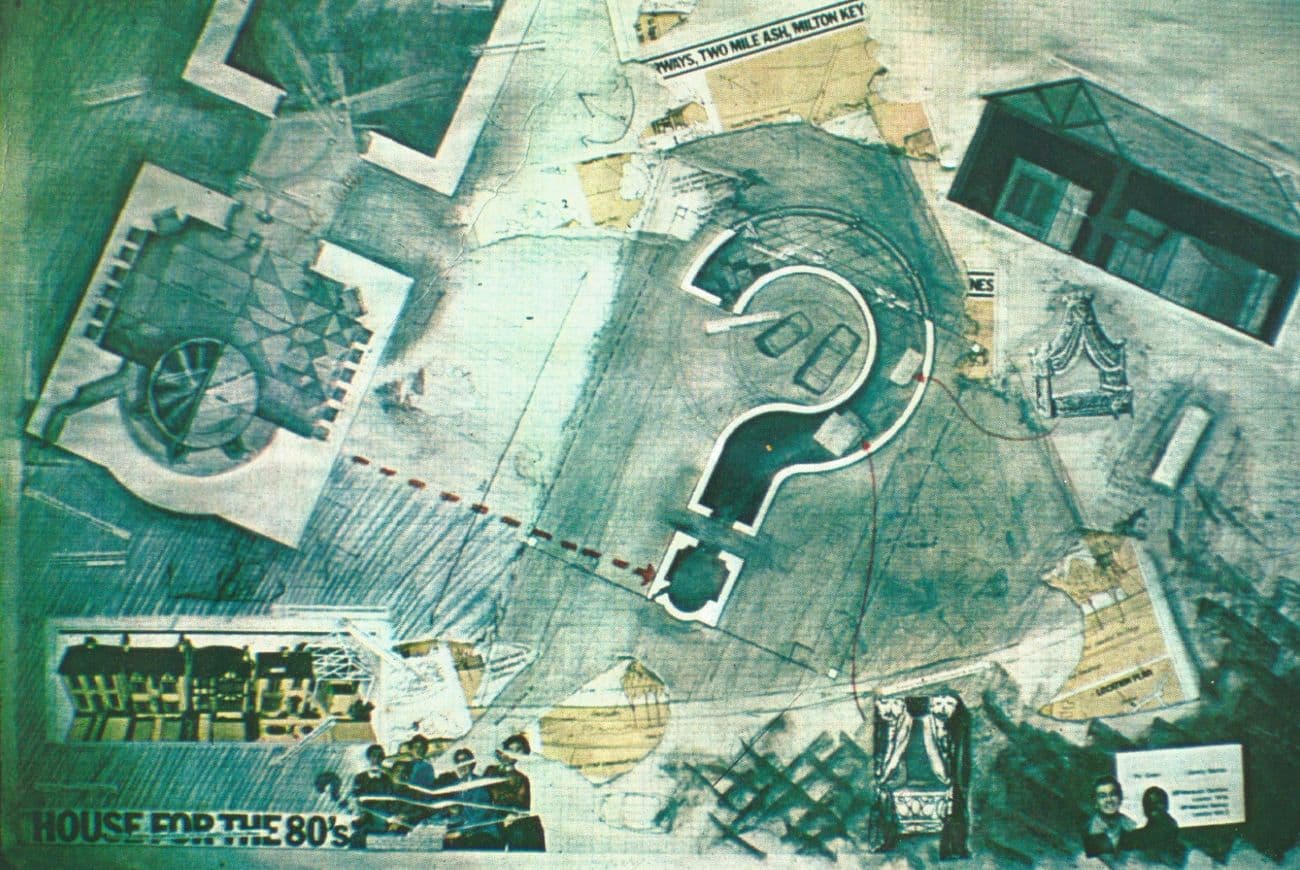
Image: Patricia Green and Jeremy Barnes 'House for 1980' Competition Entry