Sonia Syed, a third-year student from ‘Road to Nowhere’ (Experimental 5) and a team of students from DRL: Misbah Shehreen Baig, Roshni Gera, Yunzhu Duan, Elisavet Konstantinidou, have been nominated for Architect’s Journal student prizes for their projects.
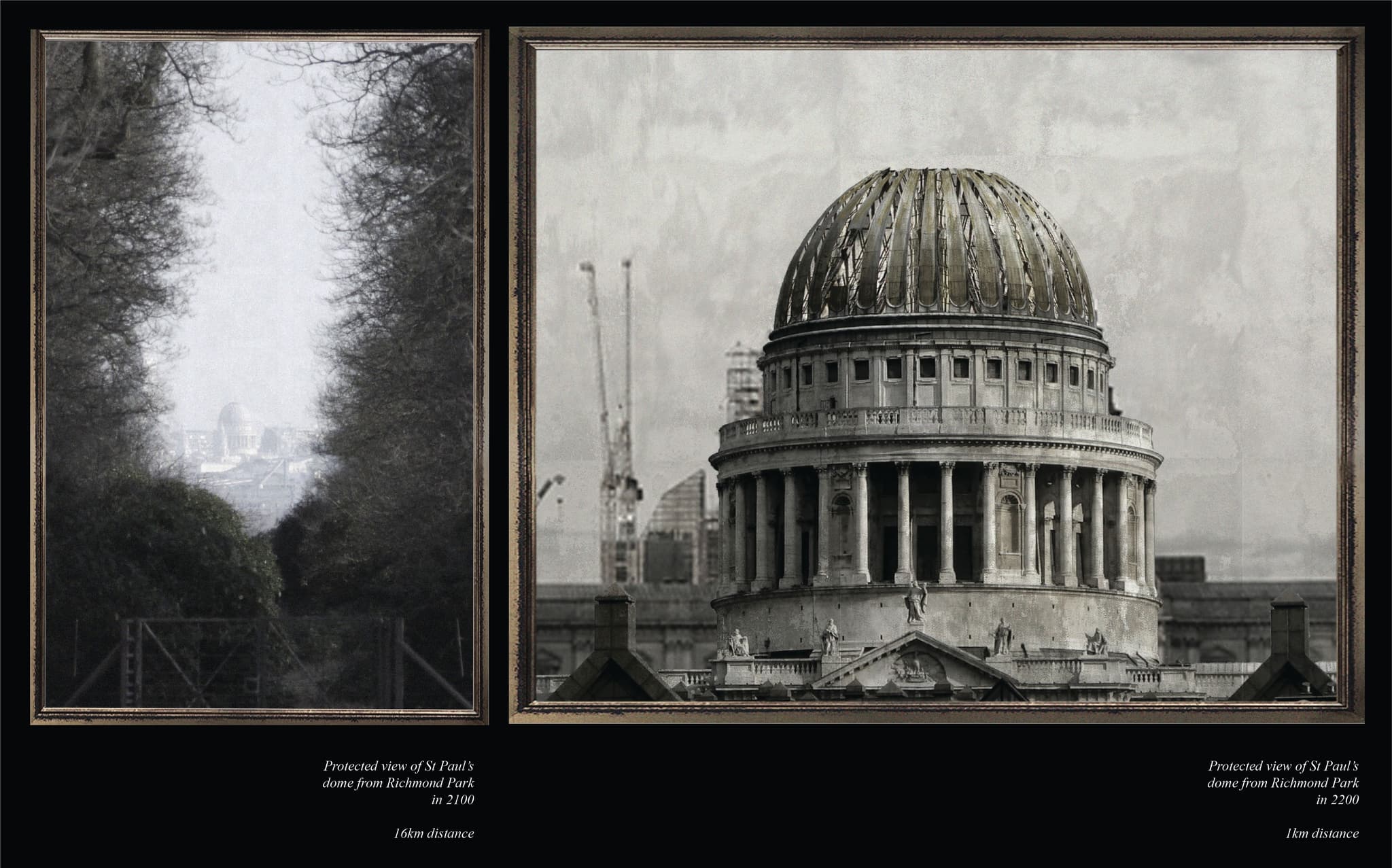
Sonia Syed’s project, titled ‘Reconstructing Conservation’ radically re-imagines how we understand architectural heritage, through an examination of St Paul’s cathedral that considers social, cultural, legal and material forces.
Sonia comments: ‘How can the dismantling of St Paul’s dome provide more value? As mentioned by Lewis Mumford, the very value of social history lies in the act of detachment. The cycling of heritage and value through architecture is questioned. This proposal sits as a new way of understanding conservation; one that takes into account the design of a building’s death along with its birth. By designing an expiry date of the physical object, there is space to allow for a narrative to be written into the gradual erasure of materiality.’
‘The proposal rests as a 600 year construction process of St. Paul’s Cathedral and rewrites the existing conservation codes so that a point towards its delisting and material devaluation exists. A new outlook on conservation areas in the City of London is then questioned. These new codes have a clear, over-arching framework of what conservation means at the beginning of this millennium; it takes 12 generations for a narrative to be forgotten, 300 years for value to lose value and another 300 years for it to be revealed. This act will be in accordance with the existing Protected View from Richmond Park so that an enhanced view is framed. Moment of delisting: 2320.’
In recommending the project for the nomination, ‘Road to Nowhere’ tutors Ryan Dillon and David Greene wrote that: ‘working at multiple scales – from the listed building details to protected urban view corridors – the proposal questions not only our material and social value systems within architectural projects, but also the governmental codes that have been written in order to protect them. As London is in constant transformation, Sonia’s project is not only historical, but also timely and visionary. The project is bold, taking on London’s most iconic heritage structure – St Paul’s Cathedral – and thoughtful in how erasure becomes a gradual act of design.’
A team of students from the DRL, including Misbah Shehreen Baig, Roshni Gera, Yunzhu Duan and Elisavet Konstantinidou have also been nominated for their project Orb[i]s. The project proposes a system of small, round, semi-autonomous robotic units that can radically reshape public spaces to change their functions and create opportunities for adaptive space-making
‘Orb[i]s is aimed at addressing the constant change in urban environments, an infrastructure that is adaptive to a continuous state of change. This prototypical system caters to the changing needs and conditions of the city by augmenting everyday activities and establishing a dynamic environment that is autonomous, adaptable and self-assembling, based on real-time data, culminating in a constantly reconfiguring ecology. The system’s spherical units can be mobile, sense one-another, and make decisions. Each unit can telescopically extend its legs and connect to others and, upon coming together, the overall system can undergo a state change, demonstrating collective intelligence that ultimately provides a higher level of adaptability. Further to its adaptive space-making ability, the system interacts with its users through illumination, with a play of light and shadow providing further transformation.’
Head of the DRL, Theodore Spyropoulos, commented that: ‘This project challenges our notion of architecture as something fixed and without agency, focusing on the emotive aspects of space and the playful aspects of human interfacing, conceiving space without a blueprint, but rather through interaction. It is an exciting project that, beyond representational means, prototyped and demonstrated the curious and human aspects that an architectural system could have in the public domain.’
We wish the nominees luck in the competition.
Read more about the AJ student prizes