Matthew Lloyd Roberts: Congratulations Marcel on winning the David and Beverly Bernstein Award for your MA Housing and Urbanism thesis. Would you like to tell us about your project?
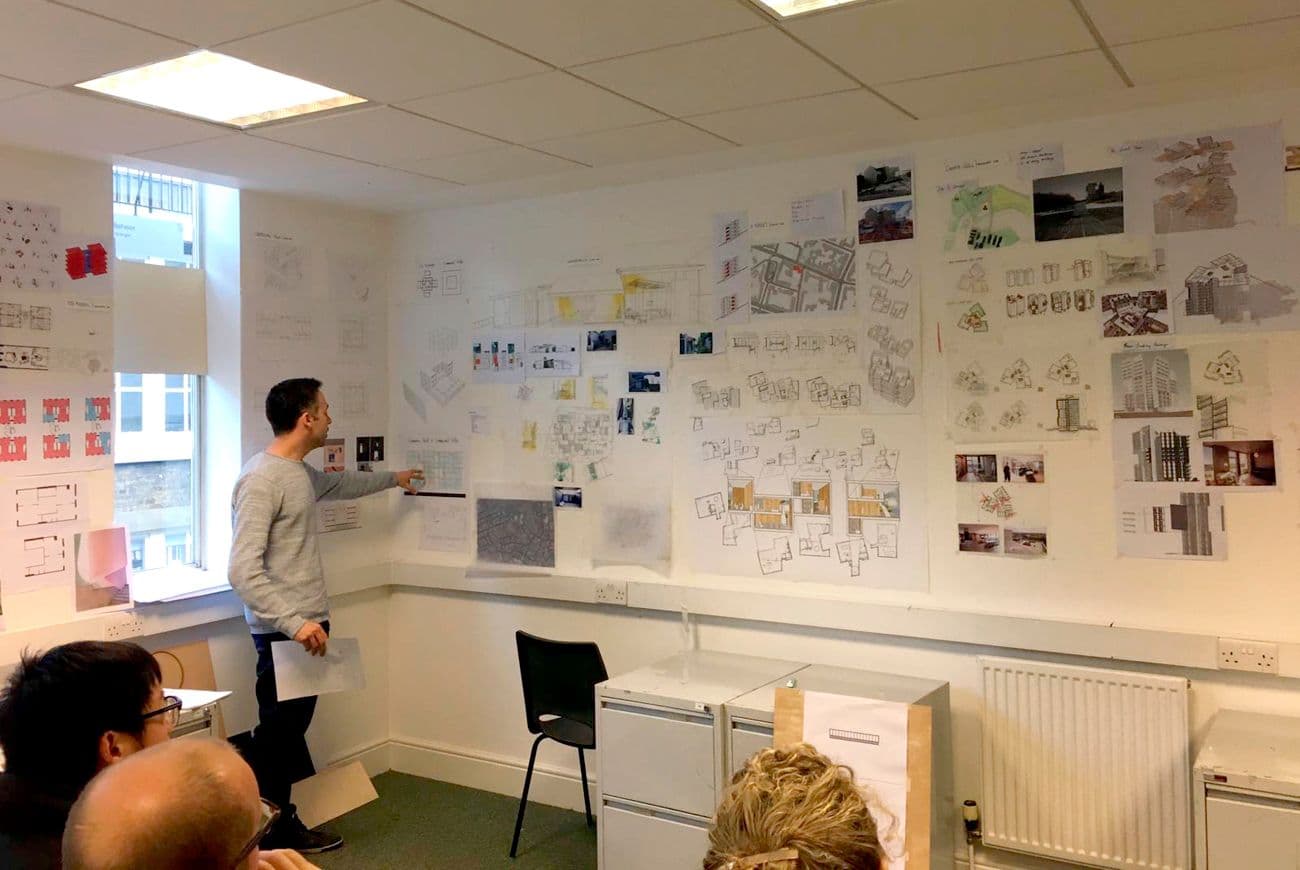
Marcel Rofatto: The thesis is a conceptual exploration of the role of the diagram in contemporary urbanism. It identifies a tendency underlying the work of some architects and the legacy of some artistic movements, and highlights the idea of directly transposing diagrams into space and the elements of design reasoning behind them. I have always been interested in those specific moments in designing when you change your mind about a subject, you have a sudden insight, and what can be a trigger for those moments. Since the beginning of my time on the Housing and Urbanism course, I have been thinking deeply about the role of the diagram. I had never thought so deeply about a subject before, either as a student or as an architect. I started to think about the way that we analyse so many immaterial and non-architectural forces that influence the urban project, and how we can methodologically organise those forces into our design thinking. Information flows, economic flows, political, spatial and cultural boundaries - how do we represent these forces as architects and make them legible? Through my research I began to explore Kazuyo Sejima’s work, and the way she handles in an intelligent manner complicated stages of diagrammatic reasoning, transposing diagrams directly to architecture. And I thought that this diagrammatic approach could be potentially transposed to urbanism, to address complexity.
MLR: How did that connection between architecture and art movements develop in your work?
MR: An important part of my research was on minimalist and post-minimalist art; we used to link Sejima to Mies van Der Rohe, and both to minimalist art, in terms of transparency, pure volumes, doing the most with the least. But studying these ideas more closely, there is this clear connection, beyond just simplistic forms, an interest in the space between things, not the things themselves. I wanted to expand this point of view into the urban field. Instead of seeing things from a dialectic point of view, such as figure and ground, landscape and building, function and form, inside and outside, form and content; expanding our way of looking to re-diagram the relationship between architecture and urbanism. Not just moving from a small scale to a bigger scale, but understanding the strategic demands of each through interstitial stages that lie between them.
MLR: I wanted to ask about one case study from your thesis, the controversial English ‘new city’ of Milton Keynes.
MR: During my studies last year, two of my tutors, Lawrence Barth and Anna Shapiro were discussing that, even though it was an theoretical thesis, it would be interesting to analyse some real cases of diagrammatic reasoning, to use as a case study to critique the state of the art. Anna is an associate partner at Sheppard Robinson, and she had been working on the Milton Keynes university campus competition. I had never heard about the town before, so I visited, to get to know the place physically, and I studied the competition entries. I saw a lot of parallels there with Brasilia in my home country, these planned communities had a lot in common both positively and negatively.
MLR: So you had a very direct connection to the place because your tutor had worked on a project there?
MR: This was one of the things I enjoyed most about the course. We have tutors with a consistent academic background, but also tutors that have been very interesting journeys through the profession. During my undergraduate years I had excellent tutors, but we used to have a very romantic, self-centred mindset in the design workshops, we weren't used to dealing with some practical issues, such as the importance of building up a convincing design argument not only to your peers but also to stakeholders and other actors.
MLR: Were there other parts of the AA that you engaged with during your studies?
MR: At least once a week I would go to public programme lectures. There was a lecture by the British artist Tania Kovats who works with cartography. And that lecture was one of those moments where you start thinking about something totally differently. I started to think about how, in the search for new design answers, we should see cities through different representational modes; not just figure ground maps or conventional maps, but distortion maps that reveal to yourself other things that were hidden. This led into my research, my academic work on scale, and I would never have made those connections if it weren't for the AA public programme.