Matthew Lloyd Roberts: Congratulations Efim on winning Diploma Honours, would you like to talk about your project, ‘Farmorama’ and your work with DIP15?
Efim Leonov: The project focuses on the crossover between domesticity — looking at the potential of ordinary domestic objects— and farmland in the UK. In the unit we work by overlapping the domestic with other programmes. In Term 1 I was thinking about the idea of dissipation, how mundane objects can become landscapes; in Term 2 we started to explore those objects in our chosen contexts, and Term 3 was about combining those ideas together into a sequence or a story.
MLR: Where was the site that the project was based in? And what domestic idea where you intrigued by?
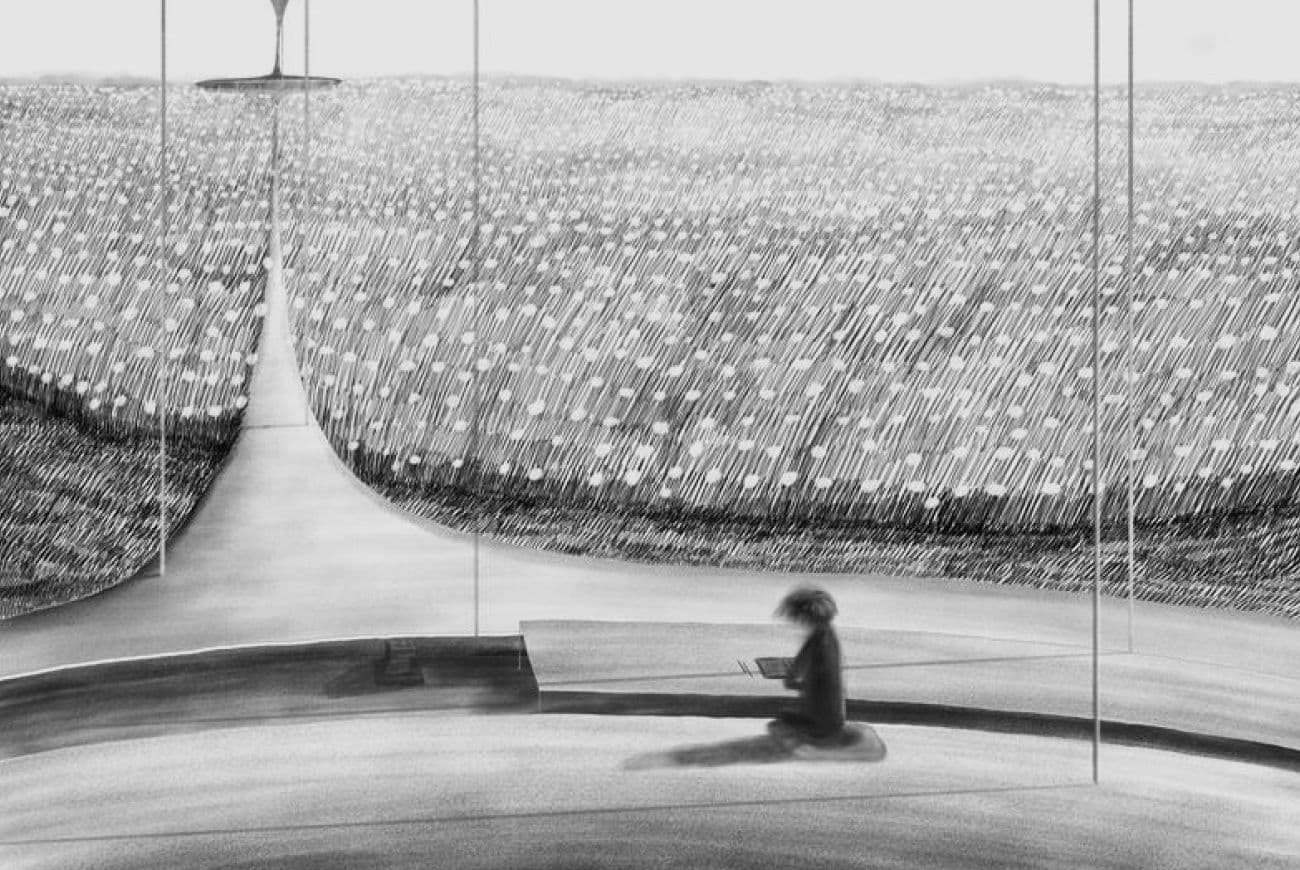
EL: The project focuses on the potential of farmland. The site was in Cromer, on the east coast of the UK and was a test ground for my proposed system. Part of the project is about recognising the social, economic and political shifts that are affecting the UK landscape. I wanted to combine this agricultural land with the Genkan — a Japanese porch typology. I extended the Genkan into the context by dissipating this threshold condition, and creating a layered ecosystem.
MLR: What was the project aiming to achieve?
EL: Three things: creating a domestic environment that takes advantage of the big scale of nature, improving the efficiency of existing farmland and increasing the biodiversity of the landscape. More specifically I concentrated on pasture because it takes up the largest portion of the countryside. By overlaying domesticity, energy production and rewilding, I attempted to create a model that could potentially be applied across the UK.
MLR: There seems to be a tension here between ideas of ‘nature’ and artificiality, how did you combine those ideas in your work?
EL: The current landscape is an artificial construct, repeatedly changed by industrialisation, monocultural modern farming techniques, and the regulations of the EU which emphasised increasing production at the expense of biodiversity in the British countryside. From 2021, after Brexit, the government will introduce new agricultural policies that prioritize restoration of biodiversity. I wanted to take that opportunity and examine the potential templates for reform, whether we could capitalise on people moving from the city to the countryside, and combine it with new technologies that improve the quality of the farmland.
MLR: How else would you like those policy reforms to improve the quality of the countryside?
EL: The current model of benefits is counterproductive. EU subsidies tend to benefit larger companies, larger land-holders, larger producers. There’s the potential for a policy shift to support smaller scale enterprises that protects the biodiversity of the UK countryside.
The majority of farmland is currently taken up by pastures. It is an incredibly inefficient way to use that land. If we could layer it with other programmes, (such as residential uses, green energy and rewilding) we can diversify the rural economy and restore a balanced ecosystem that ultimately improves the yield, the long term health of the soil and creates potential for a new way of life.
MLR: How were you thinking about rural domesticity, living in the countryside, as opposed to an urban context in your project?
EL: It is about making spaces that are respectful of their surrounding environments and that in turn benefit from the large scale of nature. Most current residential construction in the countryside is extremely detrimental to the ecosystem, so I envisaged instead a domesticity that was in harmony with its environment. It requires a willingness to embrace a lifestyle that is half-outdoors, half-indoors.
MLR: Do you think anxiety about the naturality of the countryside is particularly British? What caused these problems?
EL: Not at all, soil exhaustion from the intensity of modern farming is an international issue. We are at a critical juncture and reimagining agriculture can play a significant role in addressing environmental concerns. Many countries are following the same patterns — abandoning industrial systems in favour of ecological solutions. In the future we should be feeding the global population through functioning ecosystems that maintain long-term soil health, steady crop yield and biodiversity.