Matthew Lloyd Roberts: Congratulations Jane on winning Diploma Honours! Would you like to tell me a bit about your Diploma Project, ‘Hostile by Design’?
Jane Ching Yee Ling: The brief for Diploma 3 this year was ‘Body Politic’, which refers to Rousseau’s idea, but also the imagery of the political body, medical or otherwise. I wanted to relate that idea to my own background, as someone who immigrated to the UK, looking at migration policies in this country, which has a long history of hostility to incoming groups. In the beginning I was exploring the devices and technologies around the body with regard to migration, for example the passport as an object, its connection to the vast amount of data that the Home Office would be able to store about you, from your fingerprints to your routes of travel. This developed into an exploration of the border as a dematerialised force. Traditionally the border is the physical line around a territory, but it has been transformed into many types of infrastructure that surround us every day, surveying us, determining our nationalities and deciding what rights we are entitled to.
MLR: It is striking how little many people know about complex migration statuses, like ‘no recourse to public funds’, was educating people about those systems an important part of the project?
JCYL: An important part of working with Diploma 3 is proposing what impact your work will actually have, so I wanted to emphasise the way that my project can engage with communities, educating them about what is in their power to counter these authoritarian policies. We have a fixed relationship with the State, but my project is interested in changing our relationships to each other, encouraging a politics of care that changes our relationship from what has been determined by state policy.
MLR: How do you draw the line between architecture and other disciplines in this project? Clearly there is a rich vein of sociology, law, history and politics in your work.
JCYL: In architecture schools, we’re always told that architecture is social by nature. Evidently that has to do with the process of procuring, designing and building in the traditional sense. But in another sense, following the framework of Forensic Architecture, we can use the skills that we have as architecture students to advocate for victimised groups, through spatial analysis and legal avenues or through designing housing that is different to the repressive system of asylum seeker housing that exists in the UK today. Generally I’m more interested in what architecture can do for activism than what activism can do for architecture. How can we use the skills we already have to organise and support political struggles?
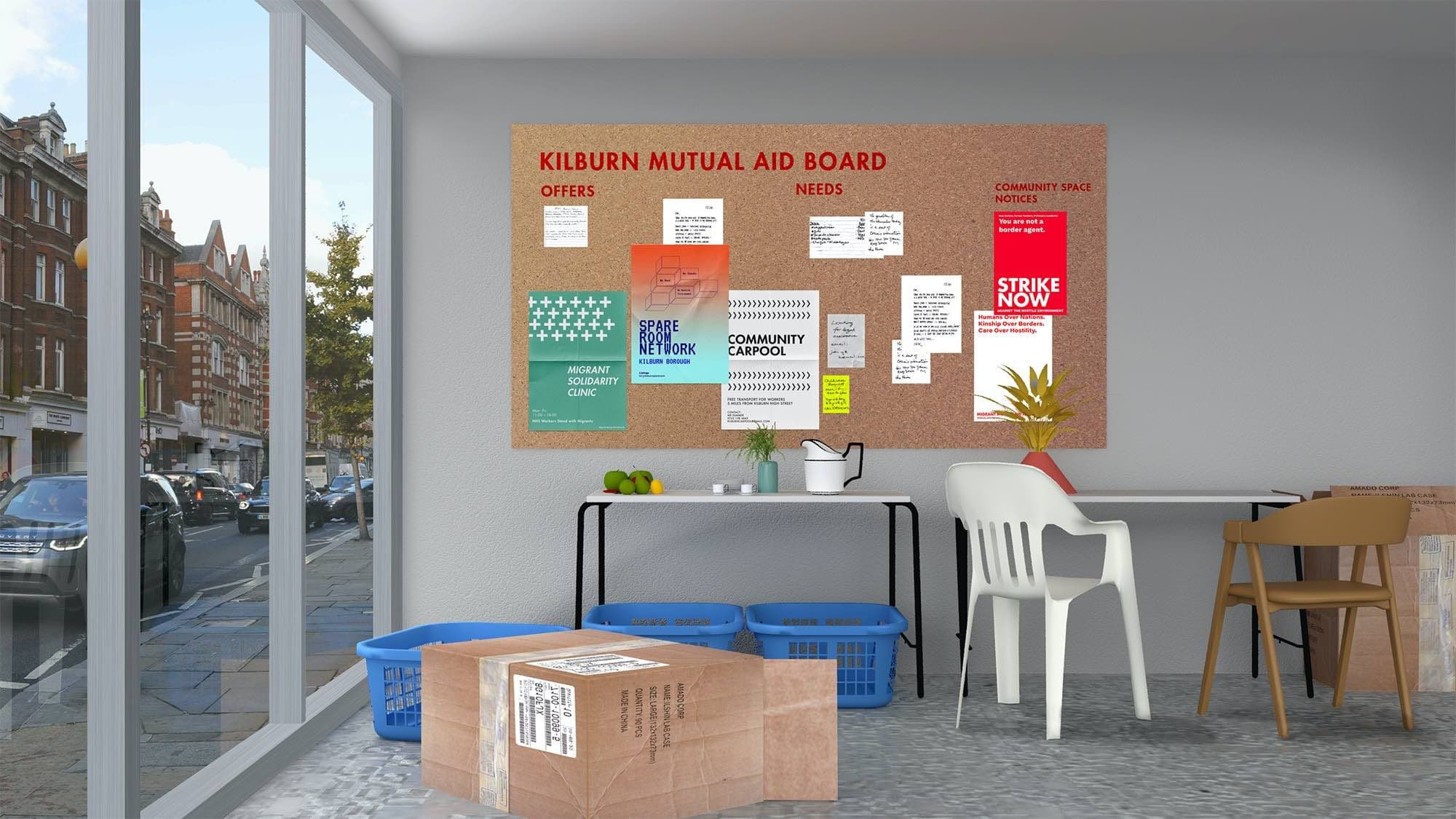
MLR: Your image of the noticeboard at a community centre Kilburn is very evocative, how do community organisations like mutual aid groups play into your understanding of migrant activism?
JCYL: Mutual Aid groups and other forms of community support are already happening, so the project is interested in taking those models and applying them to other crises that are currently under-supported. These initiatives became even more important during the pandemic, when lots of people realised that there was a need to do these things, but didn’t necessarily think about migrant groups. The project attempted to address the fact that the movement to protect migrants is lacking, is less mainstream than perhaps the climate movement in the past few years. In that case, they’ve successfully made a great number of people aware that they are responsible for what is happening. Similarly the movement to protect migrants’ rights requires a massive change in the way that people think about these issues, a need to engender a sense of radical empathy to get people to care about human beings that they’ve been taught not to care about.
MLR: The rhetoric of physical borders is extremely visible in right wing politics across the world at the moment, but as your project points out, borders are getting less physical and more technological, what do you think of that contradiction?
It is really about the image, the image of the physical border reinforces voters desire to vote for authoritarian leaders. The trend is moving in two different directions, the rhetoric is more concerned than ever with the drama of the wall or the solid border, but the actual technologies that enforce border controls are more pervasive, mundane, liquid and technological than ever before.
A special thanks to my tutors of the past two years - Christina, Merve, Antoine, and Stefan - and Natacia, Hafizah, Nicole, and Connie for their endless love and support the past year.