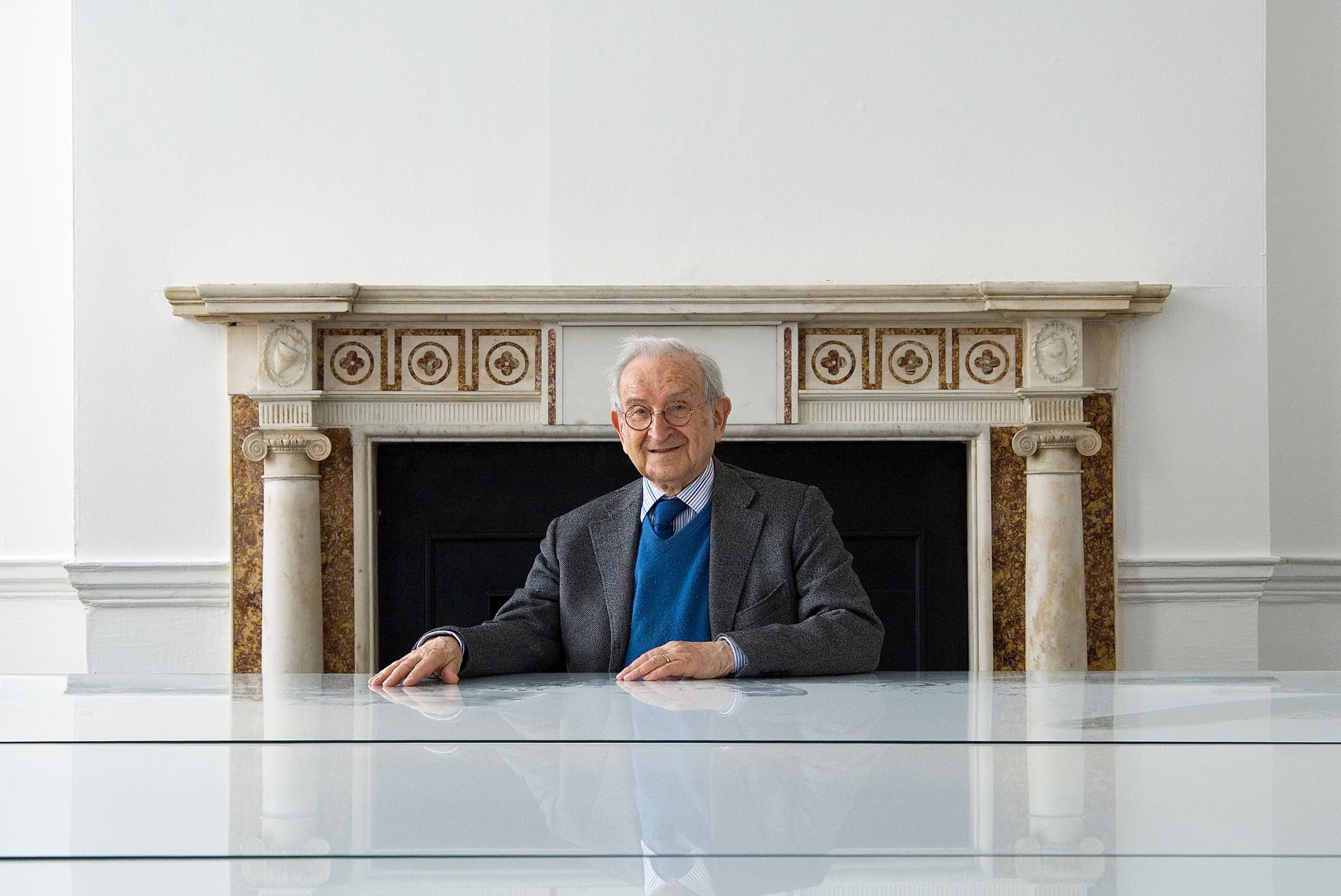
We are deeply saddened to learn of the passing of Joseph Rykwert, world-renowned architectural historian and critic, and a profoundly important part of the AA. Rykwert was an AA Member for 80 years since the age of 18, and having spent time at the AA as a student between 1944 and 1947, he remained a close figure throughout his long career as a historian, educator, and external lecturer and examiner. He remained active and involved in architectural conversation, and continued to advise a number of AA students with their thesis projects until very recently.
As Professor of Art at the University of Essex, Rykwert launched in 1967 the first postgraduate programme in the History and Theory of Architecture. He became Slade Professor of Fine Art in the 1980s and Professor of Architecture at the University of Pennsylvania in the 1990s. He ran an influential Master’s programme at Cambridge University with his friend and colleague Dalibor Vesely, and was a visiting academic at many of the world’s leading schools. He authored numerous books on architecture, and alongside English he spoke Polish, Russian, Italian and French fluently. Rykwert was made an Honorary Member of the AA in 2013. He received the 2014 RIBA Gold Medal, and in the same year was awarded a CBE by Queen Elizabeth II for his services to architecture.
Rykwert had a unique ability to build connections. Every conversation led to a remarkable story or an important architectural figure in his past, and he would point you to a specific book relevant to your conversation in his vast library. As an AA student he coincided with Michael Ventris. He was co-signatory on a student letter inviting Le Corbusier to the AA. In the early days of his career he worked for Maxwell Fry and Jane Drew, and Ove Arup. He was a long-time friend of Gio Ponti, and he remained close to many of his former pupils, such as Eric Parry and Mohsen Mostafavi. He often remarked that there are no coincidences because everything is connected.
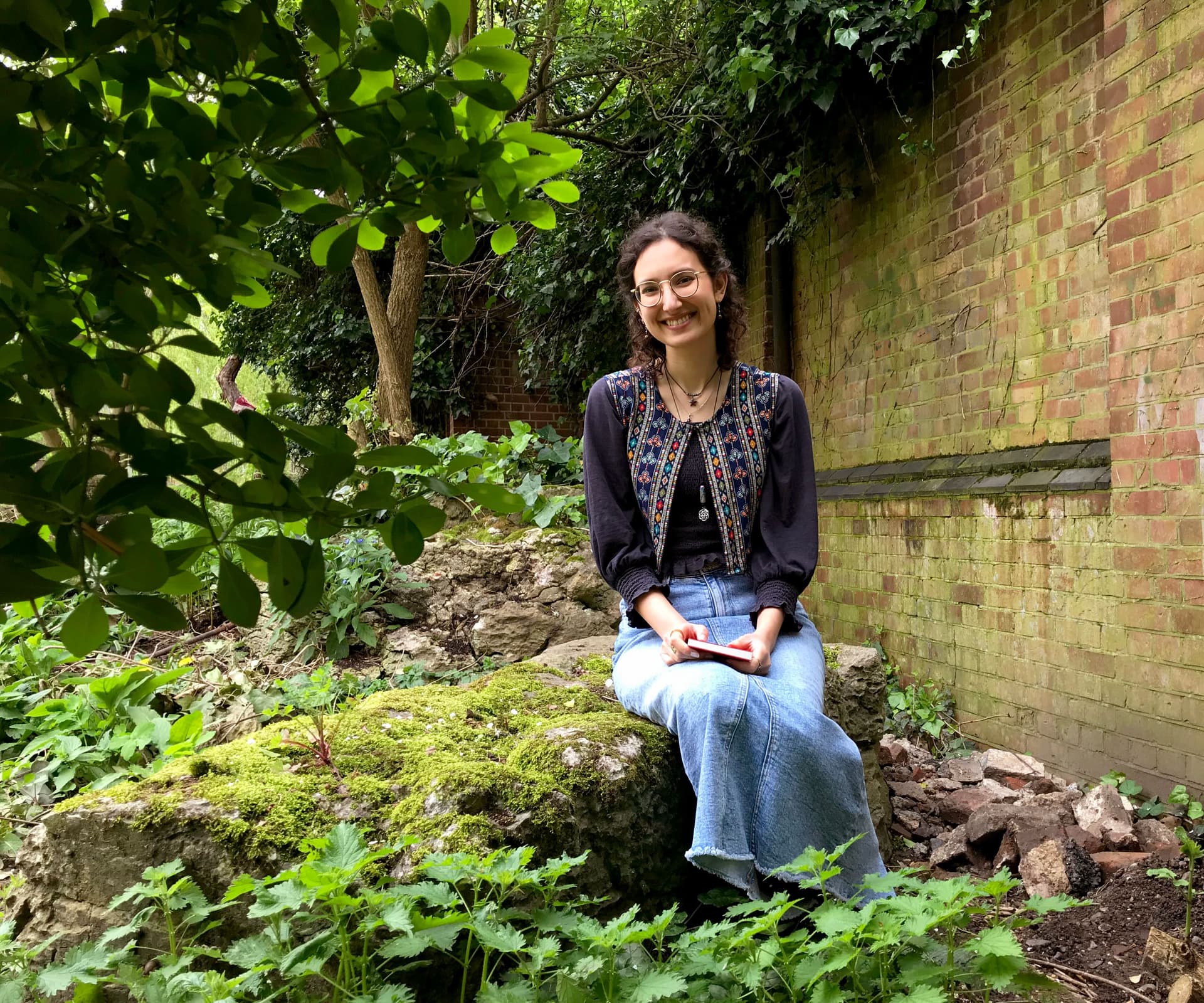
Maria Brewster, AADipl (2013) and MA in History and Critical Thinking (2018), remembers Joseph Rykwert:
In hearing the news of Joseph Rykwert’s ‘return’ [1] at 98.5 years of age, one is filled with sadness, a sense of immense loss and at the same time immense gratitude and admiration for the incredibly generous gift he offered to the architectural community. Like a Diogenes holding a lamp, his writing guided and illuminated generations of architects and critics, and will continue to have a major impact for generations to come. He was a prolific polymath and polyglot, speaking over seven languages including English, Polish, German, Italian, French, Russian, Yiddish, Hebrew, Latin and Greek. His knowledge and thought broke down disciplinary boundaries, synthesising his formal architectural education with anthropology, archeology, sociology, linguistics, cosmology, philosophy, art, history, classics, literature, religion and more. To think that his writing, although extraordinarily extensive, is only a small fragment of Rykwert’s immense knowledge, makes one wish there were another few volumes of his work. His friends and colleagues were equally from many different fields and cultures, and we are fortunate that he captured some of his personal history and relationships in Remembering Places (2017). From Wittkower to Giedion, from Corb to Eileen Gray, from Elias Canetti to Frances Yates, from C.S.Lewis to Ivan Illich, from Madame Rambert to Mary Douglas to Elsa Morante…for each Rykwert had a personal story or anecdote to share. Figures we can only read about, were part of his reality. ‘Life will surprise you by which friends stay and which friends eventually leave,’ he would say.
Like many of my generation, I encountered Rykwert’s writing a long time before I encountered the person behind the writing. I still remember carrying the The Dancing Column (1996) drawn by just its title at first, as a first year student at the AA, before discovering the most exuberating pandora’s box-completely overwhelmed and excited by what I soon discovered. His books accompanied my studies, but it was The Idea of the Town (1963) that had the greatest influence on me. It was not until my further studies in History and Critical Thinking at the AA that I had the opportunity to meet Rykwert the person. He generously went over my thesis with a red pen, commenting with just a few words on the side and directed me to a myriad of references, opening my eyes to many special places I will forever cherish. We continued the conversations since then.
‘If you go in there (in the next room), the shelf nearest the door, second shelf from the bottom, eighth book from the right, it's a red book, quite big…’ it was Joyce’s Finnegans Wake. I recall this memory, having been so impressed by how photographically Rykwert could retrieve his books from his vast floor to ceiling beautiful library, from a different room, the same precision he would direct you to the most relevant reference, even specific pages to enrich any topic of discussion. ‘Well now, look at the beginning now read the last sentence of the book, now turn at the beginning… so it's a circular book… recirculation...past Eve and Adam's... past the beginning…and you see… the mistakes in the first editions…’ Our conversation continued with discussing the unconscious: Giambattista Vico, his influence on Joyce, history, the circularity and circulation of ideas, religion, Beckett, T.S. Eliot, the Waste Land, mortality all in a few minutes… Rykwert had an unparalleled memory and observing eye, from the microcosm of his library to the macrocosm of the world. It was this capacity which allowed him to spot an error on an archaeological drawing, and go to the site with the archaeologist he was working with at the American Academy in Rome (Frank Brown), only to find that he had been of course right! – a story he liked to recall. It is also this mnemonic and associative assembly which became his method and synthetic approach, merging the architectural with the anthropological, the historical with the present, the sacred-divine and the profane, the idea with the ideal. Central to all his work was his understanding of people and their forms of life, the relationship between the body and the world, and the body as the centre and measure of that world, reminding us ‘why we build and what we build for.’ [2]
Rykwert’s memory did not fail him even when his reading became difficult: he was able to recite poems by heart including Blake and Rilke. The clarity of his spirit gave another dimension to his extraordinary capacity and his unwavering faith, resilience and patience. He continued to work until recently and leaves us with one more gift. Rykwert described Joyce as ‘probably the greatest master of English prose of his generation’; we could easily describe Rykwert as the greatest master of architectural history and theory of more than just his generation. His books and ideas will continue to influence and inspire generations to come, perpetually dancing in a continuous sentence of diachronic relevance. May he rest in peace.
[1] Paradise is a promise as well as a memory, Joseph Rykwert, On Adam’s House in Paradise (MIT Press, 1981), p 192.
[2] Ibid.