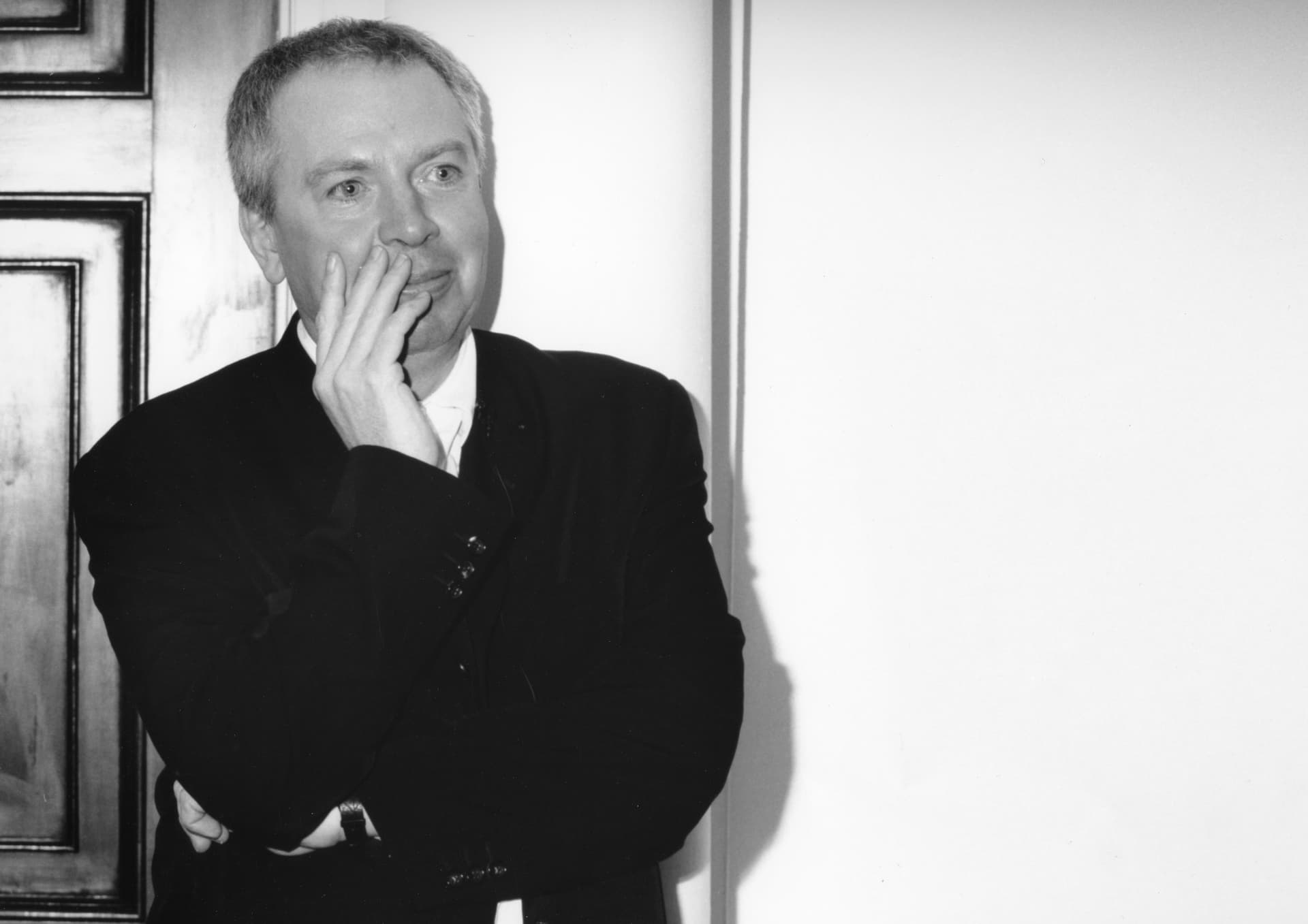
It is with sadness that we have learned of the recent passing of Julian Keable, who studied at the school during the 1940s and pioneered the multidisciplinary use of alternative technologies in architectural contexts throughout his career. Julian’s son, Rowland Keable, has kindly provided the following tribute:
Julian was the son of the radical communist vicar Geoffrey Keable and his equally radical wife Gladys. With no family money, Julian won a scholarship to the AA as one of a few school leavers studying mostly with de-mobbed servicemen, whose thoughts on radical Christianity or communism had been shaped by what they experienced in the Second World War. The AA was therefore hugely influential in a period of massive social change and informed his working life profoundly. Julian took a holiday in Israel in 1949, planning to work on the kibbutz, and discovered they were desperate for architects; the head of the AA agreed to let him practice there for half a year.
On finishing at the AA, Julian established the first of a number of busy practices in Central London. He and his wife Verena then sold everything in 1957 and travelled in a Land Rover to Turkey and Iran. Julian was inspired by the beauty and symbolism of Islamic architecture. He was not interested in empty form but rather preferred building at a scale with the street and community. In the early 1960s with Triad Architects he had a lot of success, including the commission to design the first purpose-built UK Hilton Hotel on Holland Park, a block from the family home. The building had the same proportions as the surrounding streets and sits comfortably in the neighbourhood.
At the end of the 1960s, Julian and family moved a little further north to a big house near Ladbroke Grove where he began experimenting with energy, heat and power, following the oil shocks of the early 1970s. He had a growing realisation of the damage to lives and the environment caused by pollution and fossil fuels, and an early interest in the Centre for Alternative Technology (CAT) at Machynlleth. He installed a commercial air source heat pump in the roof of the building which heated two massive water reservoirs in the basement and then pumped warm water though night storage heaters adapted to carry pipes instead of wires. He also put a wind turbine on the roof to generate 12v power, long before LED bulbs were invented.
But the architecture which he practiced was no longer satisfying. The questions of energy, design and function had shifted, and the fracturing of the design world into different professions meant that unifying a design to include materials, energy, site and situation was always out of reach. As a result, Julian left Triad and established Helix Multidisciplinary Services; a partnership of architects, engineers, service engineers and surveyors all under the same roof. Award-winning work on farms such as Bore Place, which included methane digesters to capture energy, were the result. The partnership also developed novel ‘double envelope’ passive solar designed housing – still far ahead of its time, as so much of Julian’s thinking about human organisations, energy production and conservation and design remains to this day.
The work of Clough Williams-Ellis and Hassan Fathy led to the design of rammed earth structures for projects in Tanzania and Ghana the 1970s. Julian’s enthusiasm and engagement continued into the 80s and 90s culminating in the execution, research, writing and publication of Rammed Earth Structures: A Code of Practice in 1996; now the basis of an African Regional Standard. His vision inspired many people, giving them the opportunity to work with materials and technology largely ignored or forgotten until their more recent renaissance.
To establish Helix, Julian moved to Mortimer in Berkshire and also initiated an organic farm in the late 70s and early 80s, when society was beginning to put oil shocks and pollution behind it and move into an era of ever-higher emissions and consumption. During the tough Thatcher era, collaboration in a multidisciplinary team on projects with a focus on alternative technology went against the prevailing tide; in doing so, Julian gave space for a wide variety of people to work on a range of different approaches, including a nascent Integrated Technology Power, working on a range of different turbines for pumping and power. The Helix site in Mortimer featured a beautiful wind pump for a number of years.
In 1984, as the Chairman of UK International Solar Energy Society, Julian launched the British Renewable Energy Forum as an umbrella group for other existing renewable energy groups. After his early forays with wind turbines and heat pumps he went on to pursue a wide range of design and technology routes and formed Hydrogen Solar, which engaged with the direct solar splitting of water to release hydrogen.
Throughout his life Julian grew his own veg for his family and was an active father, involving his children in projects such as the building of a geodesic dome in the back garden. He co-wrote
How the Pyramids were Built (1989), which influenced perspectives on the mystery of these giant structures. Julian looked both backwards and forwards while remaining stubbornly in the present. RIP.