Matthew Lloyd Roberts: Thank you all for joining me from Hooke Park! I was wondering, what is the AA Wood Lab and what are you researching at the moment?
Zachary Mollica: The Wood Lab has its roots in the work that’s been going on at Hooke Park over the last 35 years. It has connections to work developed by the MArch/MSc Design and Make programme, and also looking back to the early days of Hooke Park in the 1980s, with the Parnham Trust, which was led by John Makepeace, who has also funded the Wood Lab. The amazing thing about Hooke Park is that the ideas being put forward in the 1980s are still incredibly relevant and important to the future of wood and timber design. Our outlook is very much that we are standing on the shoulders of giants, so Finbar and Jack’s research is a continuation of that tradition, as well an opportunity to tell the story of the work that has taken place on the site over the years, which we are going to publish as a book.
Our view is that the future needs to be built out of wood. However, we should challenge the way that wood is being used. Often designers assume that a structure is sustainable because it uses wood, with little interrogation into the material itself. Hooke Park, and the way we build and design here, isn’t necessarily a perfect solution to these design problems, but it embodies a kind of radical questioning of how we build with wood.
Finbar Charleson: I think we’ve come to say quite often that you’re more building with trees at Hooke Park, rather than with wood. There’s a commitment to understanding how trees behave and function within the forest, and seeing what we can learn as designers from the natural strengths of the trees and the role that different species play within the ecosystem. That direct connection between designers and the forest here at Hooke Park is unique, it is very rare that researchers get to live so closely alongside the resource they’re working with.
Both Jack and I have come from very different backgrounds, and we have different expertise that we’re bringing to the project. I come from a background of architectural practice, with experience of working on projects, dealing with budgets and deadlines, and the regulatory environment, so I’m interested in how we can apply the lessons of Hooke Park directly to practice.
Jack Cardno: Yes, whereas I have a more eclectic background. I used to work as a carpenter and during that time I saw a huge amount of wasted wood, for example I worked in the theatre and just saw tonnes and tonnes of wood go straight from sets into the skip. I discovered Hooke Park first when I was an architecture student, visiting the Projects Review exhibition and ended up volunteering to work on the summer build in 2016, and totally fell in love with the place. I worked in ecological engineering, and working in outreach, so I have a lot of experience thinking about how to disseminate ecological literacy, which is central to the work of the Wood Lab. Hooke Park is fascinating in that regard because you’re observing a community, a research group, a school that co-exists with the resource that it studies and uses in its work.
Matthew: What is it like to live in Hooke whilst you’re working on this project?
Finbar: People have a lot of agency in the way they make use of the materials that are to hand in Hooke Park. The very first thing we did when we arrived was dig a huge hole, which has become a beautiful pond, full of reeds and ducks and a thriving ecosystem. This kind of work is separate from the research we’re doing, but it is so important for the ethos of Hooke and by extension the Wood Lab. There is a definite ecological literacy, an understanding that we are all impacting the environment all the time, and an engagement with the forest to ensure that the work we do is always working with, rather than against the forest. We have also been involved in the forest operations, planting more than 800 trees, which gives you an incredible insight into the way that the forest works. We want to help designers to think more like foresters, and botanists and material scientists because when you specify materials as an architect, you need to think about how the wood has been grown, and how you can best make use of its natural qualities.
Zac: I have spent the last 380 days sleeping in Hooke Park. I spent the first 95 days of the 2020 lockdown without leaving the confines of the site! We’ve had a little bit of cabin fever, but we’ve also been so privileged to be able to live and work together, and have 350 acres of woodland to roam around. We have been so lucky, but we have also missed the trickle of AA students and units that come and visit us in more normal times. We can’t wait to welcome so many people back to visit us again, and have those conversations that are so vital to connecting our work to the work of people across the school.
Matthew: Your research proposes a way of working with timber as a construction material in a very different way to current practices. How would you like architects to use wood instead?
Finbar: Designers are not the only ones who need to review their practices. There is a much broader industry that we’re investigating, as complex supply chains often obscure the origin of those materials from the architects that specify them. There will need to be a big change in these processes if we’re going to maximise the benefits of timber as a building material.
Jack: Making a tree into a rectilinear shape, like the planks of timber that we generally use in construction, is a massive waste of energy in many different ways. Every individual tree has a unique natural form and properties — a product of the way that it has itself reacted to the environment over its life. In architecture, unprocessed wood often conjures a specific twee aesthetic: people think of the rustic log cabin and things like that, there’s a certain stigma around using it as an architectural material. You can just look at any of the buildings at Hooke and see that you can make use of the natural properties of wood in a way that is sustainable and high-tech, and certainly not twee or old-fashioned.
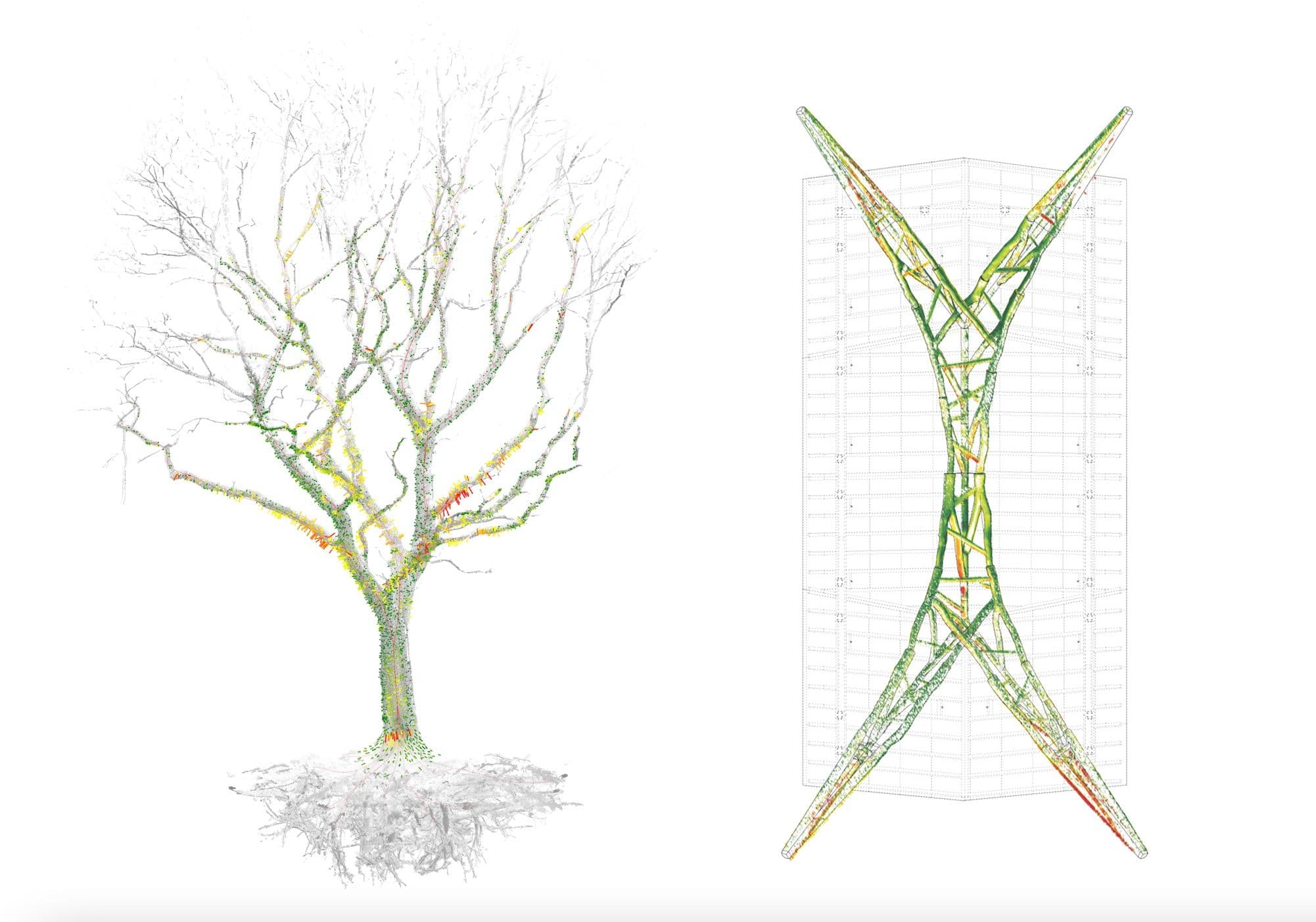
Zac: We don’t want to underestimate how difficult it is going to be to encourage architects to use wood in this way. Hooke Park on its own isn’t going to change the world, but we have shown how you can use 3D scanning and robotics to really efficiently use the tree as a building material without needing to cut it into processed lumber. We need to question the shapes of our buildings and how we build them, asking why we’re still making buildings that are rectilinear, and overwhelmingly structurally reliant on concrete, with maybe some imported and processed wood added at the end to give it the impression of a green structure. This is a humanistic problem, an aesthetic problem, an economic problem, a logistical problem, but Jack and Finbar are doing extremely exciting work approaching it from many different angles.
Finbar: I’ve been undertaking an exercise studying the Prototype House at Hooke Park, imagining if it were built according to the regulations and standards that set out structural standards in construction. Simply, an identical house built according to those regulations would use more than double the amount of material that was used in the construction of the Prototype House. This means that we can learn lessons for design and efficiency of energy and materials that extend into the way that we regulate and legislate for construction.
Jack: One of the most important pedagogical aspects to Hooke Park is just how much you absorb from living with the forest. When the Parnham Trust set up a furniture school within the forest, it was because there was a disconnection between the practice of working with wood and the origins of that material. Living in a working forest, you regularly come into contact with all of the work involved in forestry. You witness what is required to create this resource for construction. But also, you learn what is left out when industrial practices order a landscape specifically for the production of one resource only.
Finbar: When you’re working alongside a forester, we have the brilliant Christopher Sadd here at Hooke, there are so many opportunities for your design work to be informed by that knowledge of the trees as a varied and complex resource. You start to plan ahead, think about what trees will have grown in 10, 20, 50 years time, and Chris has this incredible foresight, because every day he is working with the time-frame of the life-cycle of a tree. In architecture, where the time-frames for construction are constantly getting shorter, it is powerful to think in the longer term about the resources on which those projects are reliant.
Zac: Hooke Park is this hidden away world where you can intensely work on totally new answers to profound and difficult questions, and then try to bring that work out into the world to show everyone these potential ways of doing things differently. Hopefully the work of the Wood Lab can continue that story and inspire the change that we so desperately need in the construction of our built environment.
Finbar: We’re so grateful to everyone inside and out of Hooke that have supported our work, and we can’t wait to share it with the world.
Jack: Yes, and we’re so glad that we get to work within the democratic framework of the AA, whose membership surely includes the 158,000 trees that live with us here in Hooke Park.
The Wood Lab has been made possible thanks to the generous support of John Makepeace – who as director of the Parnham Trust (1982–2001) founded the Hooke Park campus.