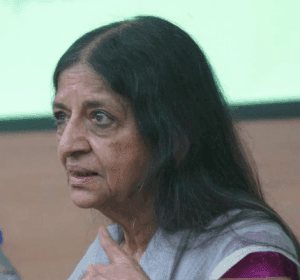
A leading activist researcher and policy advocate working at the intersection of forest management, rural development, and gender equity, Madhu Sarin was born in India to an affluent lawyer and lived in Chandigarh. Since a young age, she was a free-spirited individual who crafted a non-traditional path, valued her personal independence, and resisted social pressures around marriage. Sarin studied at the Chandigarh College of Architecture (1962-67). Despite being one of two girls in a class of thirty, she graduated as top of her class and earned a gold medal. Upon graduating, she first worked for renowned architect B.V. Doshi’s firm in Ahmedabad, then briefly set her own architectural practice with two former classmates. In 1968, she left India to spend some time in Italy doing a short cultural exchange program and briefly training at an architectural practice, before moving to London, where she worked at the Public Works Department and then at the well-known firm, Colquhoun and Miller. In 1969-70, she joined the postgraduate 'Housing Course' run by the Architectural Association's Department of Development and Tropical Studies, an experience that appeared to prompt her growing interest in critiquing modernist utopian planning, especially as it manifested in her hometown Chandigarh. After working at another architectural practice in London, she reverted to researching Chandigarh’s planning and its non-planned development, supported by a research grant – an effort which, about a decade later, culminated in her landmark book “Urban Planning in the Third World: The Chandigarh Experiment” (1982) where she analyzes how Le Corbusier’s newly planned city failed to include the poor and prompted informal forms of urbanism. By 1978, she had also returned to India and started a life-long endeavor of grassroot activism and policy advocacy focusing on the tribal land rights of rural forest communities facing eviction, spreading awareness on environmental conservation, and promoting women empowerment. Her key involvements include working with the Campaign for Survival And Dignity (CSD) which supported forest dwellers, and participating in the Ministry of Tribal Affair’s Technical Support Group which developed the Indian Forest Right Acts (enacted in 2006). Sarin has also played a key role in supporting innovative designs for improving the Chulha, an indigenous mud stove used by women in Nada Village. More broadly, she has served on the boards of many NGOs, tasks forces, and planning committees: being the president of the Vasundhara executive committee doing research and advocacy for environment conservation, the Director at the Aga Khan Rural Support Programme in India from 1997 to 2021, a member of committee for developing Chandigarh’s master plan for 2030, an honorary Fellow of the Rights and Resources Initiative (RRI) based in Washington DC, a board member in International Institute for Environment and Development (IIED) based in UK, and several other positions. Since the early 1980s, she has authored over 30 publications that span forest management, historical injustices around land disempowerment, gender equality, and women participation. In 2019, she was awarded an honorary doctorate in Civil Law by the University of East Anglia (UEA) for her contributions in field of forestry, land democratization, and feminism.
Sources
- Architectural Association Student Register 1945‐1972, AA Archives
- Architectural Association Diploma Roll Book, 1964-75, AA Archives
- Urban Planning in the Third World: The Chandigarh Experience, Madhu Sarin, 1982, Mansell Publishing
- Women Architects and Modernism in India: Narratives and contemporary practices, 2016, by Madhavi Desai, Routledge India, 1st Edition
- UK university honour for forest rights activist Madhu Sarin, Hindustan Times, 2019, Jun 16, article by Prasun Sonwalkar
https://www.hindustantimes.com/world-news/uk-university-honour-for-forest-rights-activist-madhu-sarin/story-9BxiuP1uXbgXuMLAQHSSlJ.html, accessed 21 June 2025 - Research Gate Profile Page, https://www.researchgate.net/profile/Madhu-Sarin, accessed 21 June 2025
- India Environment Portal – Knowledge for Change, Madhu Sarin Profile Page
http://www.indiaenvironmentportal.org.in/content/374170/madhu-sarin/, accessed 21 June 2025