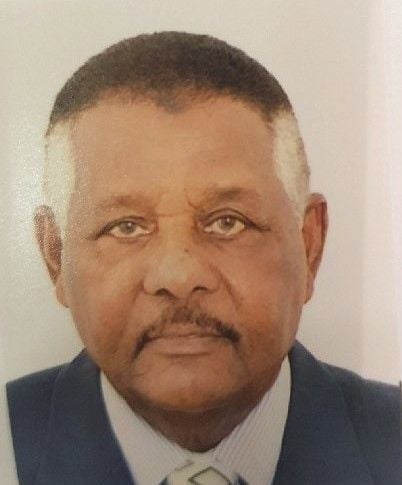
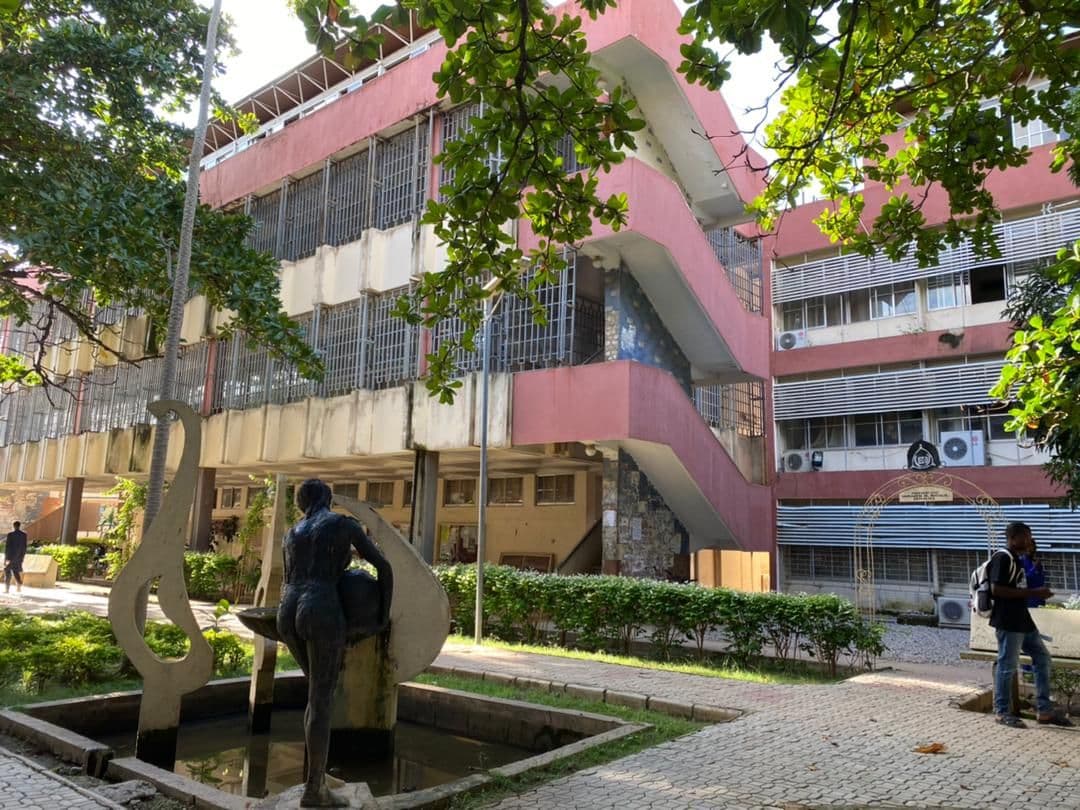
Chief Isaac Folayan Alade was born in 1933 in Ekiti, Nigeria. He was educated at Christ’s School, Ado Ekiti, from 1946-1951, before attending the Nigerian College of Arts, Science and Technology at Ibadan from 1955-57, he then transferred to the Zaria branch of the College (now Ahmadu Bello University), where he was one of four pioneering students to graduate in the new architecture school. In 1961 he passed the RIBA Final Examination, and gained employment as an architect for the civil service in the Western Region of Nigeria. Three years later, Isaac won a Commonwealth Scholarship to attend Architectural Association’ Department of Tropical Studies, in London, where he enrolled on the ‘Educational Building’ course for 1964-65. On the successful completion of his studies and receipt of the Diploma in Tropical Studies, Isaac returned to Nigeria, taking up the role of Area Project Architect for Ondo and Oyo provinces. His talents were recognised and by 1967 he was working as a Senior Architect to Lagos City Council and then, the following year, as Principal Architect for the Federal Ministry of Works and Housing Headquarters, a role he was to hold until 1972, when he became Chief Architect at the Ministry. Further promotions swiftly followed and by 1975 he had been appointed Assistant Director of Public Buildings, moving into the role of Director in 1976. That same year Fola Alade was also personally selected and appointed by Head of State, General Olusegun Obasanjo, as the Federal Permanent Secretary (Special Duties) for the Armed Force Supreme Headquarters. This was in the context of the years following the Nigerian civil war and the assassination of General Murtala Muhammad, and Isaac’s primary responsibility was related to the housing of the Nigerian military. Fola Alade retired from the civil service in 1979 and was awarded the title of Officer of the Federal Republic of Nigeria for his achievements and meritorious conduct. However, he moved directly into private practice, founding the highly successful firm of Fola Alade Associates in 1980, which he was to run for the next 20 years. Over the course of his prolific career, Isaac worked across many different scales and typologies. From his early career, projects such as his All Saints Anglian Church, Ogbonkowo, the Adeyemi College of Education, Ondo and the Land Titles Appeal Courts, Ibadan (all 1965-66) stand out. During the Nigerian Civil War of the late 1960s, he was responsible for a variety of emergency projects and undertook the design and supervision of the Nigerian Armed Forces Rehabilitation and Training Centre, Oshodi, Lagos, together with Military Hospital and Crafts Centre (1968-70). Some of the highest profile projects he worked on in the early 1970s include the National Stadium at Surulere, Lagos State (for which he supervised the construction in preparation for the 2nd All African Games of 1973), and the Federal Secretariat building in Ikoyi, Lagos (1973-76). The latter building, home to the Nigerian Federal Civil Service, was reputedly the largest structure in Western Africa at the time of its construction. Sadly, following the moving of the capital from Lagos to Abuja in 1991, the complex has been abandoned and is now in a somewhat ruinous state. He was to go on to design Nigerian Embassy buildings in fourteen countries, from which he supervised the construction of nine, including those in Accra, Brasilia, Dakar, Islamabad, Rome and Washington. Alongside this, Fola Alade designed the prototype for Federal Secretariats in the then nineteen State capitals of Nigeria (1973-76). As the focus of his work as Permanent Secretary, Isaac was to work on over 40 projects, including military barracks, cantonments, airbases, brigade headquarters, hospitals and training schools, across numerous Nigerian states (1976-1979). Of the numerous major projects Fola Alade was involved in during this period, the re-planning and development of Tafawa Balewa Square (1975-78) and the design of the Nigerian Institute of Policy and Strategic Studies, in Kuru (1978-79) are amongst the most significant. His years in private practice were also prolific, designing the Head Office for the West African Portland Cement Company, in Lagos (1987-92) and the First Bank of Nigeria building, in Akure (1984-85) - together with work for the University of Maiduguri and the Teaching Hospital complex at Obafemi Awolowo University. The foremost Nigerian architect of his generation, Fola Alade was also active within the development of the profession, serving as the first registrar of the Architects Registration Council of Nigeria (ARCON) and taking on the role of General Secretary to the Commonwealth Architects Conference held in Lagos in March 1969. He was to continue with such administrative roles, later in life, acting as Chairman of the Governing Council and Pro Chancellor of the University of Port Harcourt in 1991.
Sources
- Architectural Association Student Register, 1945-71. AA Archives
- Architectural Association Council Minutes, 19th July, 1965. AA Archives
- Architectural Association Membership Register, 1969
- Architectural Association Membership Register, 1974
- Uwechue, R. ‘Africa Who's who (Know Africa)’. Africa Journal Limited. (1991) p. 148.
- ‘Chief Isaac Fola Alade O.F.R., Hon. D.Sc., F.N.I.A, November 24, 1933 - June 18, 2021’.
- Accessed 28th October, 2025: https://www.architect-folaalade.com/
- Personal communication, Yinka Williams, Nov - Dec, 2025.