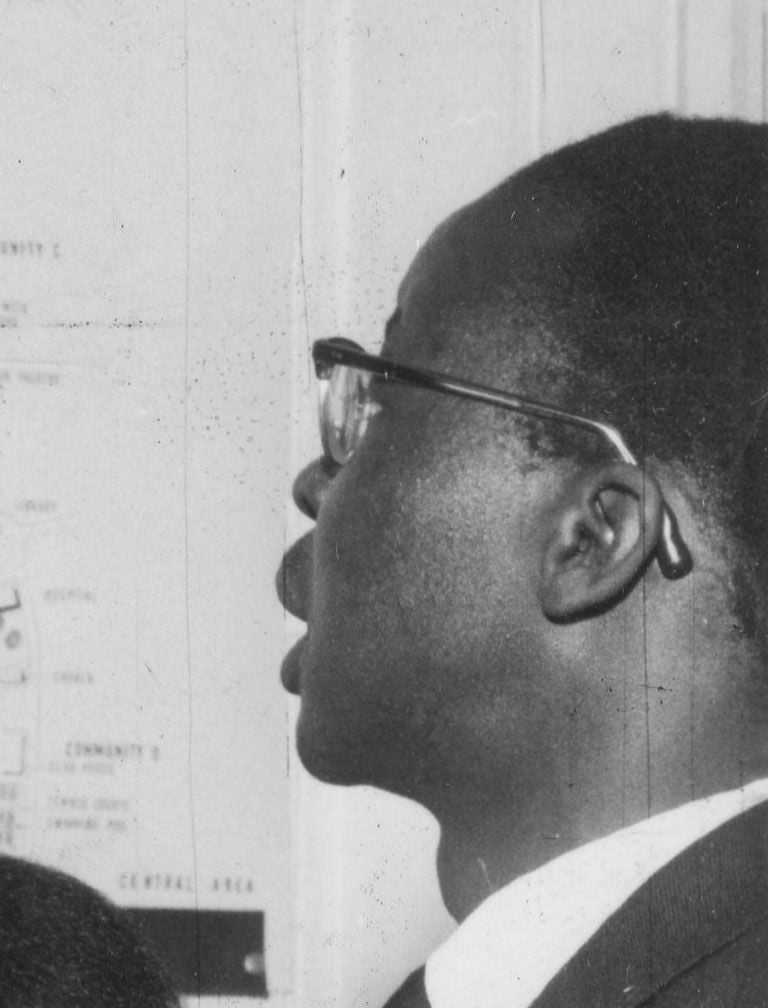
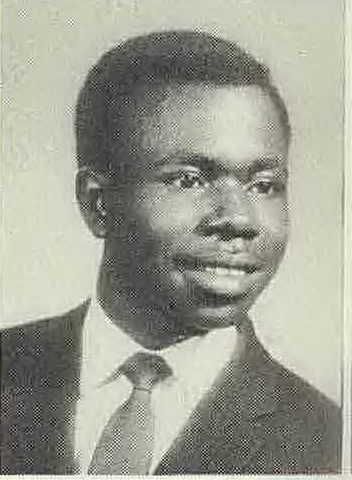
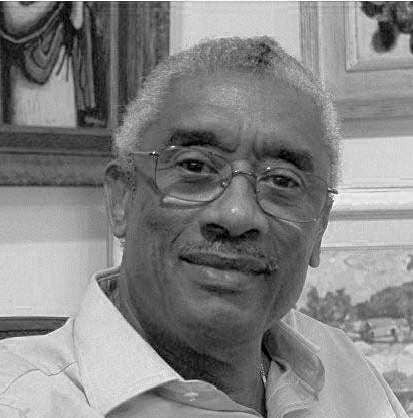
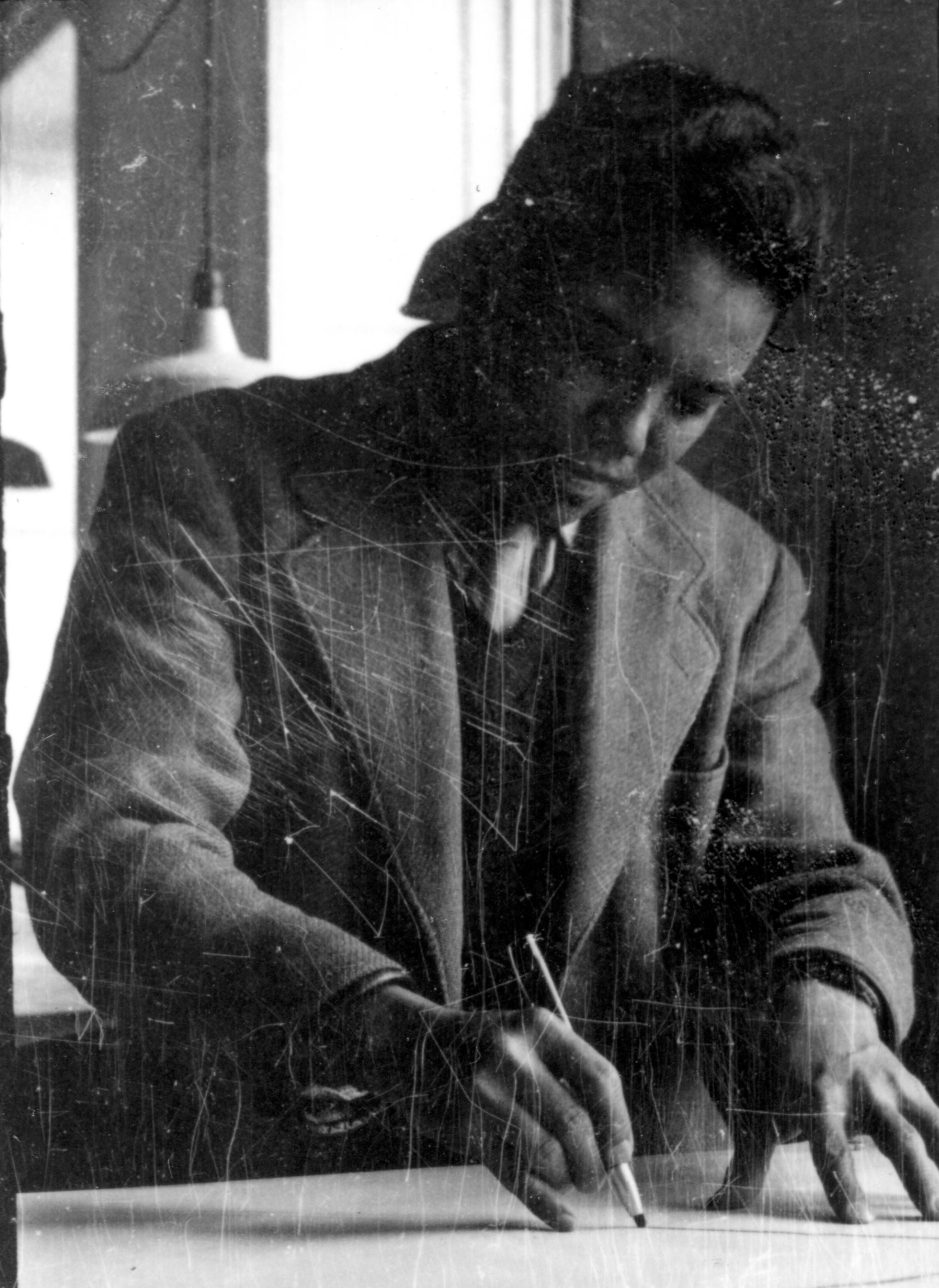
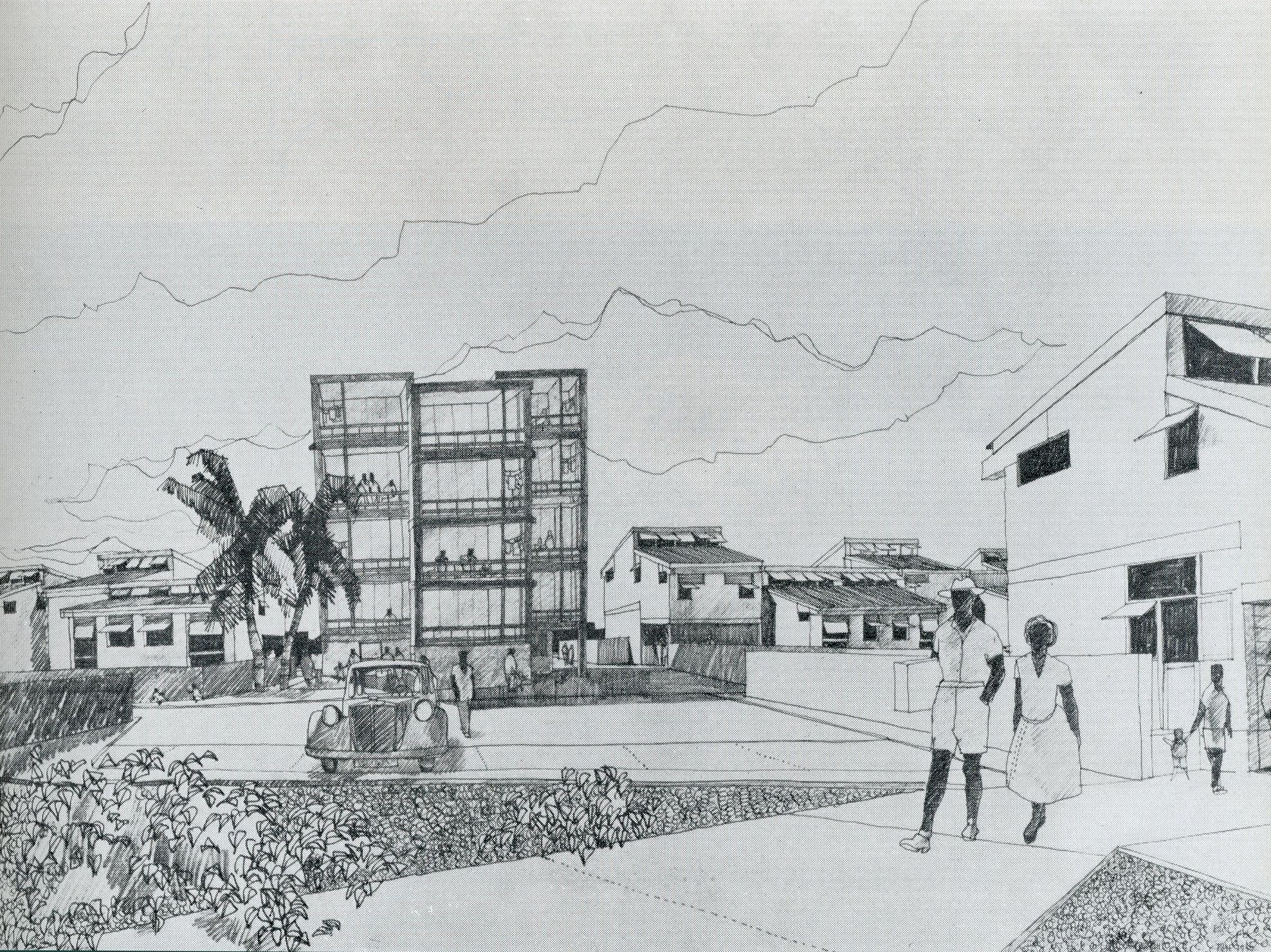
Donald Cartwright was born in Nassau, The Bahamas, in 1932. His early education is not yet known to us but he appears to have spent at least two years studying architecture at the Ryerson Institute of Technology (now Toronto Metropolitan University) in the early 1950s. During a university vacation in 1954 he is noted as assisting in the planning of the new Nassau mental health hospital, working under the personal supervision of the Director of Public Works. In 1956 he was recommended by the Public Board of Works to be funded £500 per year, by the Bahamian Government, to study at the Architectural Association, London. Cartwright duly arrived in the UK on 24th August, 1956, travelling with his wife, who was to give birth to their first child just a couple of months later. He entered the AA Second Year in September 1956 and progressed steadily through the Diploma course, taking an option to enrol in the six-month course at the Department of Tropical Architecture as part of his final year, in 1959-60. As his final year thesis, Cartwright proposed a housing project for Nassau, a perspective of his scheme being published in the AA Journal of June 1960. In September of that year, Cartwright and his family returned to Nassau, where he is recorded as joining the Public Works Department. Amongst his early work is the Dundas Civic Centre (now the Dundas Centre for the Performing Arts) on Mackey Street, Nassau. However, Cartwright was once more to return to the UK and the AA, enrolling in 1963 on the new ‘Educational Building’ programme of study within the Department of Tropical Architecture, completing the post-graduate course in February 1964. Within a year of this, Cartwright had left Bahamian government employ and set up as ‘Donald Cartwright Associates’, where it is recorded he was involved in resort developments and the design of private homes on Long Island, Bahamas. In the early 1980s he joined forces with Jackson Burnside and Patrick Rahming to form ‘The Architects’ Partnership’ before retiring to the UK later in the decade. Alongside his design work, Cartwright also co-authored one of the seminal studies of Nassau’s history and heritage.
Sources
- Architectural Association Student Register, 1959-60, 1963-64. AA Archives
- Architectural Association Diploma Roll, 1924-63. AA Archives
- Architectural Association Council Minutes Books, 22nd February, 1960, p401. AA Archives
- Architectural Association Council Minutes, 16th March, 1964, p169. AA Archives
- The National Archives; Kew, Surrey, England; BT27 Board of Trade: Commercial and Statistical Department and Successors: Outwards Passenger Lists; Reference Number: Series BT27-
- The National Archives in Washington, DC; London, England, UK; Board of Trade: Commercial and Statistical Department and Successors: Inwards Passenger Lists; Class: Bt26; Piece: 1362; Item: 113
- Architectural Association Journal, Vol. 76, No. 845 (Sept-Oct), 1960, p101
- Cartwright, D., Saunders, G. Historic Nassau, Macmillan, 1979
- ‘Who We Are – Patrick Rahming and Associates’, accessed 17th May, 2025, https://pradesigns.com/who-we-are
- Bahamas Handbook and Businessman’s Annual, Etienne Dupuch Jr. Publications, 1975, p.42.
- Bahamas Handbook and Businessman’s Annual, Etienne Dupuch Jr. Publications, 1981, p.243.
- Bahamas Handbook and Businessman’s Annual, Etienne Dupuch Jr. Publications, 1984, p.32.
- Bahamas Votes of the House of Assembly, Bahama Legislature Council, 1956, p.XIX, p.100